
PoH-Code: poh.27467
Gabrovica, Žena Printery
—
partizanstvo.si / Arhiv Geopedia · CC-BY 4.0 (privzeta licenca) · Preneseno iz Geopedije.
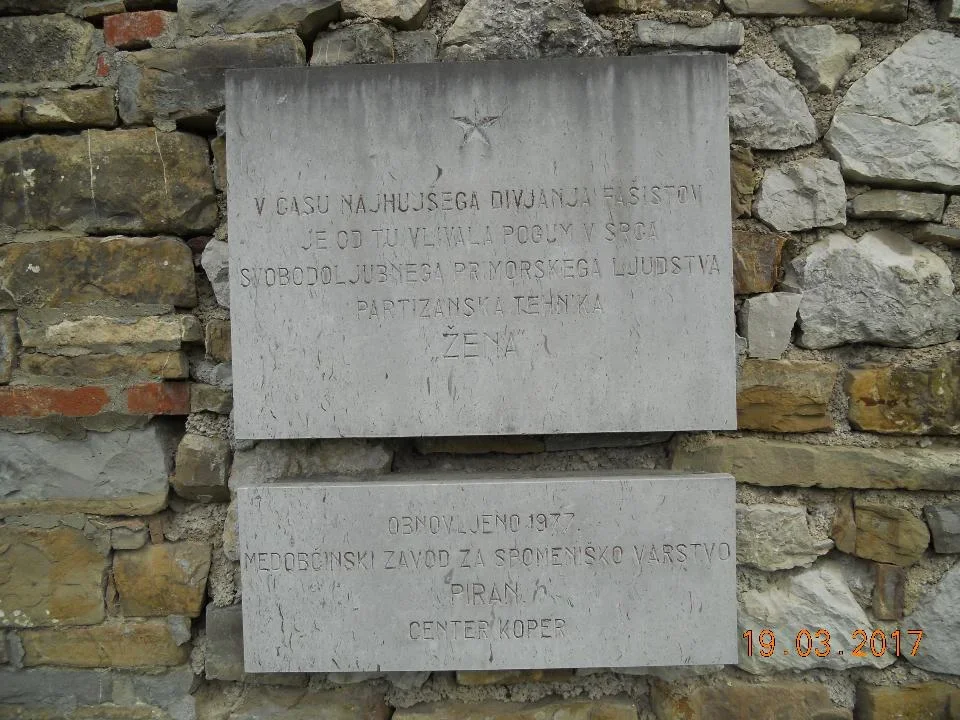
Memorial plaque at the printing house and at the printing house ŽENA. The preserved part of the house in which the partizan printing house ŽENA operated. The building was completely restored and presented in 1977.
EŠD 1322
.
The magazine Slovenski Jadran from 1955 reports:
»'IN THE TIME OF THE WILDEST FASCIST FEROCITY …', as the plaque says, life was burning with all its might in the village. From Brkini, from Idrija, from Trieste, from everywhere, couriers and partizan patrols came day after day under these shelters. In all directions, they were richly equipped with all kinds of goods: weapons, food, clothing, medical supplies, and partizan literature. Yes, this village was a bridge between Trieste and the rear. Freedom-loving villagers did everything to ensure that the partizan units, which bravely attacked the enemy and controlled a large part of Slovenian Istria, were supplied with everything they needed. Materials were collected from all sides, brought by special couriers from Trieste, from Milje, Koper and surrounding villages. Here was also the partizan printing house. It printed a large part of the Primorska region. It started its work already on 9 May 1943. It was called 'Naš dom' and had its headquarters in Bertoki near Dekani, barely 500 m from the house of our pioneer Ivan Caha-Iskre. [..] At this place, the printing house operated until 20 October 1943, when it had to move to a safer place due to the proximity of large cities and the increasing danger of being discovered. That night, brave couriers carried all the material of the printing house, including the machines, on their backs to the village of Gabrovica, where Valerio Barut had already prepared a carefully prepared bunker. For this, they used the space of a wine cellar, which they divided with an internal wall so that a third of this space could accommodate all the equipment of the printing house and its workers. In the front room, in the corner of the floor, there was a tight square opening, which was closed by a heavy concrete slab. Along the walls of this front room, strong beds were laid on which large barrels and crates were placed. Everything was arranged so that in case of danger, one of these barrels could be rolled into the bunker opening and thus completely hidden from the enemy's view. In this space, where not even a ray of sunlight had ever fallen, the printing house worked undisturbed until 28 May 1944. It changed its name to 'Snežnik' and later to 'Žena'. From the narrow, dark and damp space, new and new bundles of Radio Vestnika, Primorski Dnevnik, the list Unita, numerous brochures, as well as various forms, which the developing people's authority needed for its work, came day after day.
On 28 May 1944, dark clouds gathered over the village. Strong German units, whichThey came from Kopra and Kozina, and in the early morning hours, with three rings, surrounded you and searched the village with great intensity for the hidden bunker. At that moment, the high patriotic awareness of the villagers showed, who, despite the worst pressure from the Germans, did not want to betray the hiding place. In the last moment, Nevenka Barut, the ten-year-old daughter of the householder, succeeded in moving the lid of the bunker's opening and thus closed the entrance to the technical area, where all the technicians remained. The Germans caught Nevenka just before entering the cellar. With beating, they wanted to force her to reveal where the bunker was. But the girl held out. The Germans, in a furious rage, began to rampage through the village, drove away the livestock, and made the inhabitants suffer on trucks to take them to internment. From the houses and farm buildings, flames of fire were planned. The enraged Germans began to shoot around the village, killing the sick woman Ivančič Marija, who was lying in bed, and threw Križmančič Nazarij alive into the fire. But the village held on.
When the Germans, after finishing their plundering, left the village, the remaining villagers opened the bunker and pulled out the barely alive technicians from the burning ruins. Even after the fire in the village, the technicians continued their work until September of the same year, when the Germans, in the burned village, established their garrison. At that time, the partisans and activists hid all the machines in a natural cave above the village. The remaining villagers dug out what remained of the Polish tools from under the ruins and ashes, and on June 12, 1944, established the Peasants' Cooperative.«
Emil Smole, Our Cultural Monuments Gabrovica, Slovenski Jadran, Year IV No. 48, Koper, Friday, November 25, 1955, p. (6–7).
Electronic source: Slovenski Jadran, no. 48, 1955, p. (6–7) Access: 22. 2. 2024.
Translation · AI tier 7
Sources
- Partizanstvo.si — Partizanski spomeniki (#1252) (7815910b-c137-4639-b92e-c04e131cc58a) — Partizanstvo.si — Partizanski spomeniki (#1252)
Links
Location & map
Map position available (Point) · spatial accuracy: 4 — Accurate
Textual location description
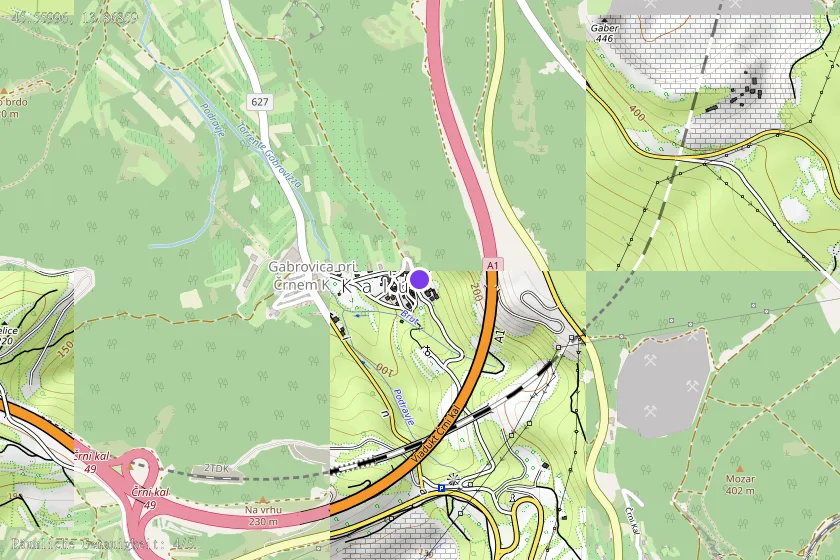
V vasi Gabrovica pri in na partizanski tiskarni ŽENA sta postavljeni spominski plošči. Hiša je stala v sredi stare vasi Gabrovica, danes nad vasjo Gabrovica.
Coordinates (WGS84)45.55996° N, 13.86859° E