PoH-Code: poh.27640
Francka Zupančič
—
Memorial plaque for activist Frančiška Zupančič, who was killed by local volunteers from Kleč near Ljubljana on 29 November 1944. The plaque was unveiled on 30 November 1963.
Source: Vodnik po partizanskih poteh, Ljubljana: Borec, 1978, p. 38.
Sistory states First and last name: Frančiška Zupančič, Father: Janez, Mother: Frančiška, Native name: Vračeva, Date of birth: 21. 01. 1907, Place of birth: Spodnji Kašelj, Place of residence: Zgornji Kašelj, Old municipality: Polje, New municipality: Ljubljana, Date of death/disappearance: 29. 11. 1943. Place of death/disappearance: near Kleč, Place of burial: Polje.
»Frančiška Zupančič-Vračeva's fate was entirely different. She began working for the OF as early as 1941 and connected her work in the family home, where she had already, from childhood, replaced her deceased brother's mother and took care of her father, the household, on the fields, in the forest, and around, knowing every inch of land, every path and every hidden shelter. […]
One day before the burning of the paper mill in Vevške, at the end of August 1942, she still used the opportunity to attend a partisan rally in the woods between Češnjica and Zagradišče with some of her collaborators.
Under the pretense of going to bury the recently deceased Resjak's mother, the Italians allowed them to cross the mined bridge. When the women returned home the next day, the guards arrested them, claiming they were in contact with the partisans who had set fire to the paper mill at night. Francka Zupančič was among those arrested. She was sent to the concentration camp on Rab Island. […]
In May 1943, Francka Zupančič returned home and immediately resumed her work. Polish Bela Gardisti ordered her to report to their post every day, but due to urgent tasks on the field, she was unable to comply with their order.
Upon returning from internment, Francka noticed that many of her collaborators had switched sides to the white guards. […]
The informants constantly warned her. […]
On 5 October 1943, Francka still crossed the Ljubljanica River in a boat late at night carrying weapons and blankets. After 10 pm, she locked the house door and lay down. She had not yet fallen asleep when someone knocked loudly on the door and called out that she had to open it immediately. She was frightened, but even more so was her elderly father, who was very attached to her. She reassured him that nothing bad would happen, but even she was plagued by terrible suspicions. The local volunteer who opened the door ordered her to come with him immediately.
She dressed and quietly left the house. Outside, she saw several local volunteers waiting for her, some of them in the garden of the neighboring house. Together, they all went towards the railway station. […]
From the railway bridge, the volunteers chased Francka up the hill towards the Dimnik Canal. In front of her walked one man, while the others formed a line behind her. […]
They were approaching the path that winds along the banks of the Ljubljanica River, already close to her outflow into the Savinja. In the middle of this path, the column stopped. The volunteer who walked in front of Francka suddenly turned around and shot her in the chest. She fell on her face. While lying on the ground, she was shot twice more. One shot hit her chest again, but neither the first nor the second shot pierced her heart. The third shot was aimed at her neck. The bullet entered through the doorframe, exited just below her ear.The presumed dead were dragged and thrown into the Ljubljana River. It seemed strange to them that they had not heard the sound of water, but they could no longer manage to look and see if the body had perhaps fallen on dry land. Below Ljubljana, already on the right bank of the Savinja, the Germans were guarding the railway track. They began to fire back at the home guards' shots. Soon joined them the fascists from the railway bridge in Zalog and from the Kašelj Bridge. Neither one nor the other knew why or at whom they were shooting.
The home guards were most terrified, thinking that the partisans Francki had arrived to help. They left the victim on the bank of the Ljubljana River and fled from the site of the massacre to a prearranged location. […]
While the home guards were searching for Stefan Alič, Francka lay in a deep unconsciousness. After two hours, she woke up around one in the early morning. She long tip-toed around herself and painfully thought about where she was and what had happened to her. She felt terrible pains in her head. She could not lift herself up; even thinking about standing up was impossible. With both hands, she held onto her head and tried to support herself on the pillows, hoping to look around, but it did not work. She began to crawl up the bank on all fours, like an animal. […] There are no more houses below the path along the Ljubljana River. […] Francka's house in Spodnji Kašelj was about ten minutes away from where she lay. […] She began to crawl towards the first house, which was only a few tens of meters away from her. […] But crawling and waiting was in vain. […] Due to the night shooting, people were so frightened that they did not dare to move. […]
Exhausted to death, Francka was seized by fear of what would happen to her if the home guards returned. […] She thought of Jurkove's house, the last in the row, already completely below the bend of the road. […] In the final moment, they pulled her into the house. Behind the bend, the footsteps of the home guards were already echoing.
In the house, Francka lay unconscious. […]
The Jurkovi did not know how to help the half-dead acquaintance. They were also disturbed by the thought of what would happen if the home guards discovered the trail of their victim crawling towards the house. […]
The Franckis washed her face with warm water, not daring to do more, and feared for her all night. When it seemed appropriate, they sent for her relatives. […]
Francka's relatives sent for Dr. Richard Gregorčič to Polje, who had treated wounded and sick partisans and activists. He arrived immediately and offered Francka all the help. Slowly, she regained consciousness enough to describe the terrible crime. Francka's brother Anton Zupančič, married in Zalog No. 100, did not want to leave his sister near the terrible event. In the evening, he came with a car, took her, and lifted her from the divan.
[..]
Francka endured unbearable pain for a week. [..] Her relatives wanted to take her to the Ljubljana hospital's war injuries ward, but they knew the home guards would not grant them permission to transport her through the block. After one week, they finally succeeded in taking her to the hospital in Ljubljana with the help of German soldiers along the side paths by the Savinja. […]
Francka Zupančič was being treated on the war injuries ward from October 12, 1943. […]
On November 29, 1943, around 11 o'clock, a well-known military bus from Polje stopped in front of the general hospital in Ljubljana. Three home guards got out of it and first went to the deaf-mute institute opposite the hospital. […]
For some time, Zakovšek was alone in the bus, then Francka was brought in. Two of them supported her so that she could walk, and helped her into the bus. [..]The bus with Zakovšek and Zupančič arrived at the forced labor camp on the other side of the Ljubljanica river shortly after leaving the hospital. From the prison cells labeled 'forced labor', the local volunteers brought in a third arrestee: […]
Francka Zupančič no longer thought of herself. […] As the bus approached Polje, she still said: 'For such a great cause, as we are fighting for, the sacrifices are necessary. I accept it as those before me have already done, and those after me will have to do as well.' […]
When it got dark, the Polish volunteers took Francka towards Ježica. The car stopped near an abandoned gravel pit halfway between Ježica and Vižmarje, about half an hour away from Kleč. […]
The executioners pulled Francka out of the car and threw her under the 'martro'. […] Urhovski and Polish volunteers knew she had already been shot once, but she had recovered. Therefore, they tried harder to properly carry out their bloody business. With rifle butts, they smashed the victims' heads.
Francka lay under the cross in the middle of the Ljubljana Field all night and the entire next day. Only on the second night did the Jesuit volunteers take her to the cemetery's mortuary and place her on the bearers for the cross. The mortuary was locked, and they took the key with them. […]«
(Štefanija Ravnikar-Podbevšek, Sv. Urh, Chronicle of Events from the National Liberation War, Ljubljana: Borec Publishing House, 1978, pp. 313–318, 363–365, LXIV [photographs and text below them])
Translation · AI tier 5
Sources
- Partizanstvo.si — Partizanski spomeniki (#7339) (e43b5c03-23ae-4151-b4c9-3d01758796d5) — Partizanstvo.si — Partizanski spomeniki (#7339)
Links
Location & map
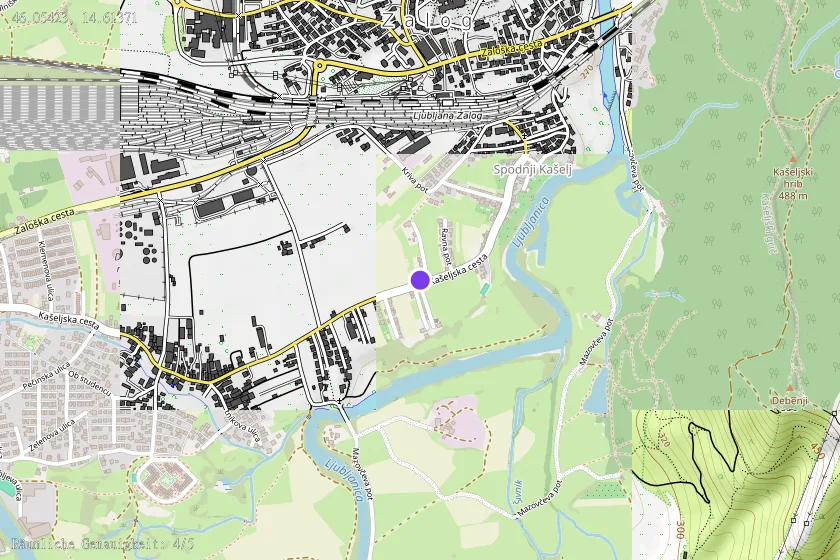
Map position available (Point) · spatial accuracy: 4 — Accurate
Textual location description
Kašeljska cesta 50.