PoH-Code: poh.27087
Alojz Handler, Travna gora
—
partizanstvo.si / Arhiv Geopedia · CC-BY 4.0 (privzeta licenca) · Preneseno iz Geopedije.
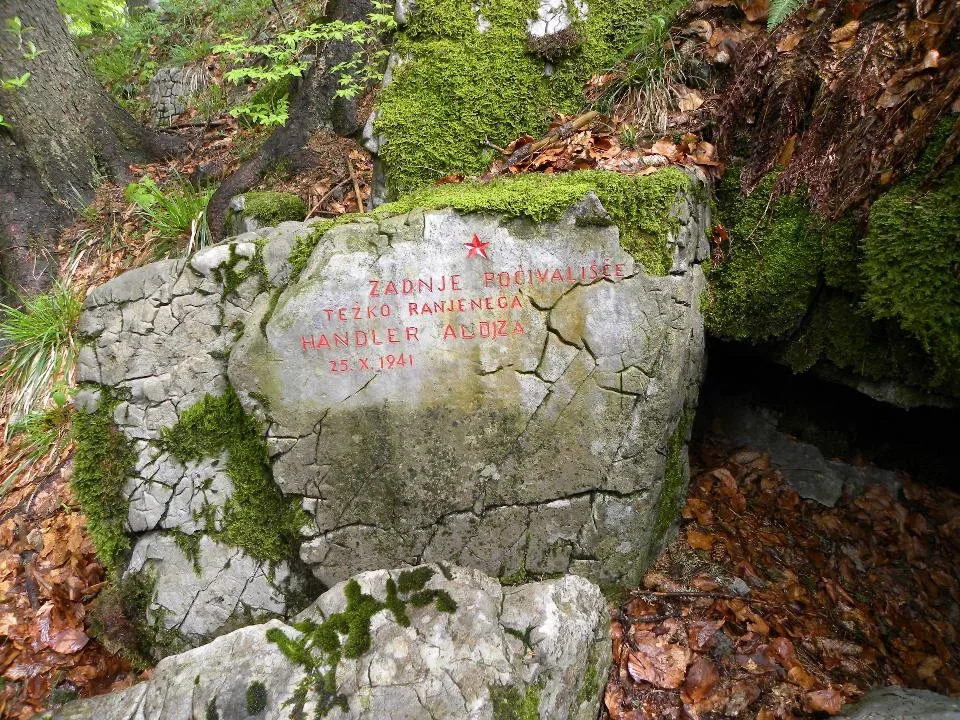
Original stone slab, which was in place of a gravestone and attached to the trunk of a tree, was made of wood and had an engraved message. It has been made of metal since August 2019, measuring 70 x 5,0 cm, consisting of a load-bearing base - sheet metal, painted red, above it a 2 mm thick corten steel plate, which has cut-out letters or the entire message.
The slab was made and attached by members of ZB NOB from Sodražice.
»Description of Handler Alojz according to the memories of Toneta Ožbolt and his companion Nosan Staneta, deceased original founder Mihelič Vinka from Ribnice and Zdravka Troha.
It was still snowing. The detachment for a meeting in Ravnem Dolu, consisting of the commander, the commissar and four men of escort, had driven into the snow up to the waist and had begun to clear a difficult path across Travna Gora. They had already spotted the well-known chapel and were approaching it step by step. It had not yet occurred to them that anything dangerous might be there, since they had passed by it many times safely. And just there the Italians were waiting for them and attacked them. Partisan Anton Juriševič-Kovačičev Tonček from Sodražice, originally from Podgrad on the Primorska, who had been the last organist in Mozlje near Kočevje, was mortally wounded. The following days they secretly buried him in Sodražice. Alojz Handler, a Kočevski German from Stara Cerkev, who had been brought into the unit by the district secretary Jože Šeško with praise and recommendations, was mortally wounded. The wounded comrade was picked up and they withdrew back along their own trail directly to the partisan camp under Velbo – since nothing else was left for them. Fortunately, the Italians did not follow them through the snow.
The partisan camp of the Ribniška unit then experienced its first fear. In a hurry, they discussed and came to the realization that they were surrounded or would be in the shortest time. They knew that the enemy would not go into the forest with small forces and that therefore they should not accept battle or try to escape from the Italians in the snow-covered forest. They decided to break out of the circle into the valley and spread out there. But what about the wounded man? They could not carry him with them and suffer him, since his wounds were so severe. The pain was painful and tormenting for all. The mortally wounded and helpless comrade remained alone under the tent in the partisan camp with compulsory chest wounds. Without words, he looked desperately for his comrades, as if he knew that it had to be like this. The comrades set up the tent, erased the trail, comforted the wounded man and promised him that they would soon return and take him to the village where he would be healed. There was plenty of clothing, food, weapons and other supplies in the camp, but it was hard to find a person who would care for and guard the wounded man; he himself forced them, nevertheless, to go, so that they would not be caught and killed by the Italians. Then they left the camp and the wounded comrade without hesitation and drove into the snow completely. Avoiding known paths and crossings, they forced their way through secret passages and successfully escaped from the enemy's circle.After the meeting at the bakery and the conversation with Gašper—near Beli Mlin in Žlebič—Vinko Mihelič told the courier Stan and his comrade Aliča that a seriously wounded partisan had remained under a tent in the partisan camp below Velb, and that he had to be rescued immediately and brought down into the valley. Vinko Mihelič equipped them with rations, bread, rum, tea, sugar, and food. On Monday morning they set off into the forest as innocent peasants or foresters. They avoided the Italian path and successfully reached Travna Gora. They also avoided the inn at Lenček, where the Italians had arrested Sodražan Ivan Čampo and Jožeta Lavrič, took them away and tortured them. They evaded the Italian army and returned to the valley. The next day they again tried to cross Ravnega Dola, and with skis on their shoulders they plunged into the deep snow and climbed onto the steep mountain. The partisans had to carry out the mission without conditions. All day they climbed the hill, dug through the snow, and arrived in the dark at Rusov's hut. There they spent the night, made tea, and rested.
'The wounded man has already been four days without help inside the enemy's circle, with mortal wounds, if they haven't already taken him,' the fighters thought and guessed how they could get to him and what they would find in the camp.
Stan Nosan remained silent. He looked around the dangerous, snow-covered mountain terrain and skied into the snow, with Aliča following behind and pushing him forward. They skied and skied, as if the skis were more needed than their legs, climbing up the slopes and descending into the valleys, brushing the snow away with branches and getting caught in it, finally crossing the enemy's circle safely and quietly approaching the abandoned campsite. Judging by the tracks, the Italians had not yet discovered the camp. Perhaps they would only find the wounded comrade Lakner, rescue him, and bring him down into the valley, for those who had successfully evaded them. 'In fact, we are already in the camp,' Stan said to himself when he saw the tense snow-covered ridge above the collapsed tent.
They looked at each other and started searching. They dug through the snow and brushed it away, lifted the tent fabric, and uncovered the sleeping place. There was no sign of the wounded man. Only a few small items with a shaving kit and a cap were on the sleeping place, with dried bloodstains, but no wounded man anywhere. They had already thought that perhaps the Italians had discovered the campsite and taken the wounded man away, since the snow, which was still falling, had covered the tracks of the partisans and the enemy.
Stan lowered the tent fabric from his hand, which again covered the sleeping place. Then they continued on and searched for the wounded man, because Stan hoped that the man, although seriously wounded and in great pain, had moved a few hundred meters away from Velb, where the main headquarters had previously been stationed. Perhaps, in his final moments, he had still wanted his belongings and the sleeping place.They walked through the snow until they reached Velba and saw a strange stone shelter at the top of the mountain. It looked like something from a fairy tale. Inside, they found a room that was five steps wide and ten steps long, hidden in living, eternal stone, with an entrance on the northern side, and the back wall facing the sunny south-west. The side walls were made of living stone, a thick layer of earth and stone lay above the roof, and thick mountain trees grew above that. Storage areas for weapons and food were arranged between the walls. They saw that the weapons were untouched, the military uniforms and clothes were neatly folded and arranged, as were the food supplies. The common resting places were covered and dry, neatly arranged and covered with thick military blankets, which had a tribarcolored stripe of the national flag on the sides. And on one of the resting places, in the middle on the southern side, they saw an injured comrade, who neither stirred nor paid them any attention. He lay covered with blankets and wrapped in a blanket. His head was raised, his eyes closed, and his face was pale and cold. Before falling asleep, he had taken off his wristwatch and placed it on his left shoulder. Beside the watch was his diary, to which he had only written down his last feelings, so that those who found him would know when he had fallen asleep. On the right side, next to him, lay a military rifle with a pouch for ammunition and some bombs. His right hand lay across his chest, while his left held an open book, with his thumb between the pages. It was his last friend, whom he read until he was alive, before he fell asleep forever. He no longer needed help from people now.
The comrades returned to the valley without him. They had already reached Rusovka hut, exhausted and wet, before dusk, where Alič took charge and stayed the night, while Stane returned alone to the valley at night.
(Zdravko Troha, Življenjepisi in spomini nekaterih kočevskih Nemcev in partizanov, Kočevski Nemci - partizani, Ljubljana: Slovensko kočevarsko društvo Peter Kosler, 2004, str. 58–60)
Kočevski Nemci – partizani in aktivisti Osvobodilne fronte 1941–1945
Alojz Handler (Franc Lakner-Pepček), a tailor from Stara Cerkev near Kočevje, born in 1914, was a partisan of the Ribniška četa from July 1941. He, along with two other Slovenians, Lisac Lojza-Mora and the secretary of the OF from Kočevje, was brought to Travna gora by the Ribniška četa. In the second half of July 1941, Professor Jože Šeško, then secretary of the Regional Committee of the Communist Party for Kočevje, brought them to Travna gora. Franc Lakner was seriously wounded in battles with the Italians on Travna gora in the second half of October 1941 and died within a few days despite the lack of medical care and support from his comrades. At that time, more than a meter of snow had fallen on Travna gora or the wider area.
(Zdravko Troha, Moja razprava na zborovanju slovenskih zgodovinarjev 10. in 11. 4. 2001 v Ljubljani, Kočevski Nemci - partizani, Ljubljana: Slovensko kočevarsko društvo Peter Kosler, 2004, str. 92)
Sistory states: Name and surname: Alojz Handler, Date of birth: 04.06.1913, Place of birth: Stara Cerkev, Place of residence: Stara Cerkev, Marital status: No data, Profession (social status): tailor, DATA ON DEATH, Date of death / disappearance: 25.10.1941, Place of death / disappearance: Travna gora, Place of burial: Velika gora, Country of burial: Slovenia
Translation · AI tier 5
Sources
- Partizanstvo.si — Partizanski spomeniki (#2024) (778a8ed6-d6ac-4d57-9958-1ece6b344d05) — Partizanstvo.si — Partizanski spomeniki (#2024)
Links
Location & map
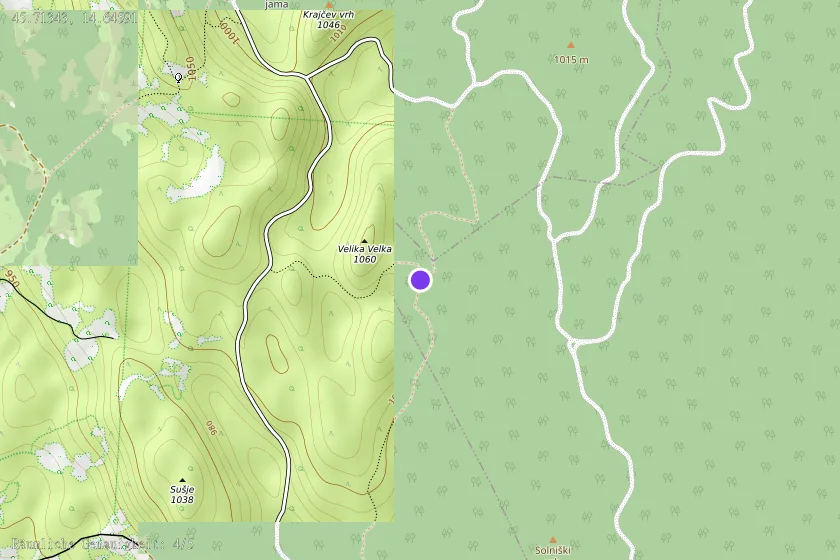
Map position available (Point) · spatial accuracy: 4 — Accurate
Textual location description
Od Doma na Travni gori gremo po cesti najprej proti zahodu, nato pa se cesta obrne na jug. Po okoli 2 km pridemo do Boštjanovega štanta - križišča, kjer pot nadaljujemo še naprej proti jugu in to okoli 1 km, kjer pridemo do izogibališča oz. razširjenega cestišča, tudi zlagalnica debel (45˙42´49,49˝ - 14°38˙45,11˝ ). Tu moramo na deblih na levi strani cestišča poiskati narisane smerokaze in markacije in gremo po njih proti vzhodu in po enem kilometru poti pridemo do Velba.