PoH-Code: poh.22721
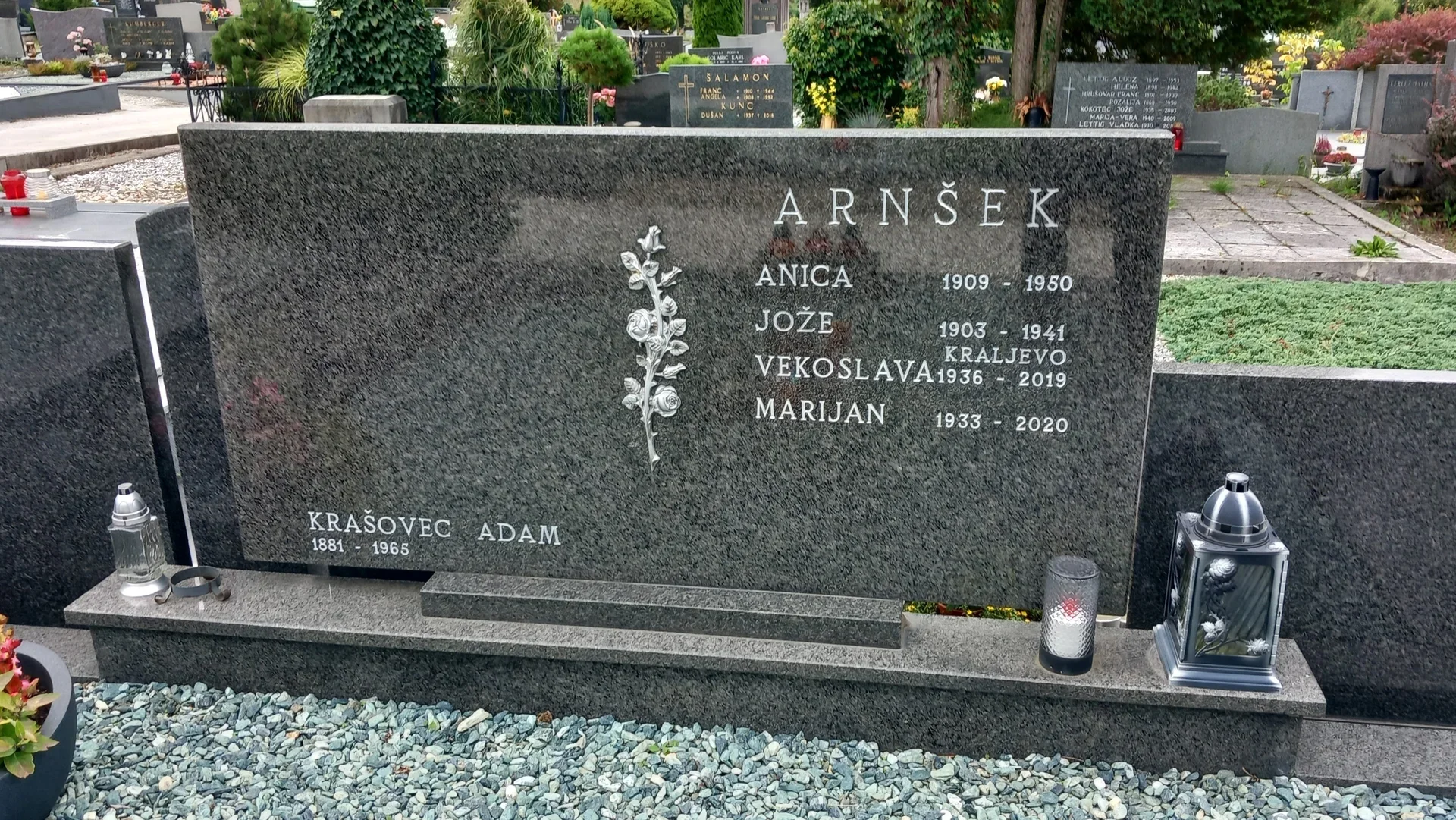
Celje, cemetery, Jože Arnšek
—
partizanstvo.si / Arhiv Geopedia · CC-BY 4.0 (privzeta licenca) · Preneseno iz Geopedije.
Arnšek Jože: Sistory states: First and last name: Jožef Arnšek, Father: Peter, Date of birth: 00. 00. 1903, Place of birth: Videm, Krško, Place of residence:
Sevnica, Old municipality: Sevnica, New municipality: Sevnica, Profession (social status):
official, Date of death/disappearance: 16. 10. 1941, Place of death/disappearance: Kraljevo, Country of burial: Serbia.
Between the 15th and 20th of October 1941, the Germans in Kraljevo shot 2190 men, a woman and a child, because the partisans and fighters in a joint action had killed 14 and wounded 10 soldiers of the Wehrmacht. For this retaliation, they decided according to a strange German mathematical formula: shooting a hundred Serbs for a dead German and fifty for a wounded one.
»The men of Slovene nationality were shot in Kraljevo, who were not employed in the railway workshop: 23. Jožef Arnšek, tailor
[…]
Jože Arnšek
Jože Arnšek was a tailor by profession and worked in Sevnica, later in Celje, where he was employed in the workers' association. He was born in 1903 in Blanci. He married Anica Babič.
Arnšek had to represent workers' rights by his official duty, and since he himself was a worker, he also felt the need for every worker to be protected. His area of influence was quite extensive. It included Celje, the neighbouring Štore and Liboje. In Celje, he never stopped fighting for workers' rights. In the years 1939, 1940 and at the beginning of 1941, he became even stronger. The trade union movement was especially emphasized, which most developed in the Westen factory. The factory management naturally did not like this, so it is no wonder that they wanted to get rid of the responsible workers' representative as soon as the German occupiers appeared in Celje.
The Arnšeks were immediately arrested in the Capuchin monastery and were treated there with their usual methods. In June 1941, they were transferred from Celje to the Melk military camp in Maribor, where they also brought his family. In the German evacuation report, we can read that on 1st July 1941, Jožef Arnšek, his wife and his sons Marija and Ciril were evacuated.
Ciril was the youngest and still in diapers, he was barely two months and two days old when he, along with his mother, his brother and his father Jože, were evacuated to Serbia. In Sevojno near Užice, they were handed over to German soldiers, who then imprisoned them. After a few days, they were forced to work on the fields, on some estate fields, and under German supervision. After a few weeks, the German soldiers suddenly disappeared. There were not many Germans left. The Arnšeks continued to work on the fields, but no one gave them food anymore. They had to take care of themselves. They replaced what they could with what they had managed to save from the German occupiers in Celje. Soon, money and everything they had of value were gone. Then they moved to Aleksinac. There, Jože's father got a job as a driver in the mine. He worked there from 5th August to 1st September 1941, when he had an accident and Arnšek had to go to the surface for help. One can imagine that the work in the mine was too heavy for a tailor. Eventually, Arnšek got a job in the aircraft factory in Kraljevo. Perhaps it would have been better to stay in Aleksinac.The family was taken to Trstenik, where there were more Slovenes. In Kraljevo he was alone, and on Saturdays he would drive to Trstenik and return to work in Kraljevo on Monday. He only went to Trstenik, which was 29 km away, four times. On Saturday, 4 October 1941, Arnšek could not go to Trstenik, because the Germans, together with workers from the factory, had locked him in the notorious locomotive hall of the neighbouring railway workshop. Arnšek wrote a letter to his wife Anica on 3 October 1941, asking her to buy bread and eggs, so that he would be able to live more cheaply and easily in Kraljevo, because he had found the food in the tavern too expensive.
[…]
Of course, the letter from Jože Arnšek could not reach Trstenik by post. It was folded into a square, and on the front was written on a torn-out sheet of paper from a notebook: G. Arnšek Anica, Trstenik. How the letter arrived in Trstenik and into Anica Arnšek’s hands will remain a mystery. For at that time Kraljevo had been surrounded for more than forty days by the patriotic units, partisans, and chetniks. A friendly person had to deliver the letter much later, after the October tragedy in Kraljevo.
No matter how the letter arrived in Trstenik, Anica Arnšek received it and kept it faithfully until her death. It was the last letter from her Jože.
Did anyone suspect that the next day, on Saturday 4 October 1941, he would not be able to leave Kraljevo, since the German occupiers had turned it into a city of sorrow?
Anica Arnšek and other Anas, Angelas, Pavlas, dozens, hundreds, and thousands of women, mothers, sisters, and fiancées initially believed the rumours spread by the Germans, that the workers had been taken in artificial fog to work in eastern areas of Germany. Some immediately understood that this was a lie, while others did not want to give up the hope that they would one day see their husbands, sons, brothers, and fiancés again and embrace them.
Anica Arnšek had already realized early on that all hope was futile, and she wanted to return home to Slovenia immediately. She obtained a certificate from the parish office in Trbovlje, stating that her father Jože and her grandfather were from Trbovelj, that her mother and grandmother were from Dola near Trbovlje, and that all were Roman Catholic and true Aryans. With this certificate, in December 1941 she received a travel permit from the German military command in Kraljevo to travel to Belgrade. Anica thought that with this she had opened the way home. But only the desire remained. The German authorities had indeed requested such 'Aryan' certificates, but only for domestic use. They had no special value.
With her two phantoms, she had to return to Trstenik. There she joined the Slovene colony, led by the Hrastljevs, Fleretovs, Rozmanovs, and others. There were about thirty families, and they shared food once a day from a common pot. Anica helped in the kitchen, earning herself a meal and her two children. Her son Marijan helped in the paper shop, distributed newspapers, and, with his modest means, contributed to the livelihood of his mother and brother, who was still under her care.
On 25 August 1942, Anica received a death certificate for her deceased husband Jože Arnšek from the Roman Catholic church in Kraljevo. With it, she could prove that her husband had been shot on 16 October 1941 as a civilian. Thus, she could apply for a pension after the death of her husband. In the devastated Serbia, the Serbian authorities considered that all shot civilians had lost their lives during work, and automatically granted them ten years of service. The question of pensions and support was resolved quickly, but they only covered a small part of daily needs, especially if there were underage children in the family.In Trstenik, the family of the deceased Arnšk lived in hardship and lack.
They awaited the day of liberation and could return to their native places.»
(Rudi Steinbücher, Oj, zdaj gremo /Slovenski izgnanci v Kraljevu/, Ljubljana:
Založba Borec, 1988, pp. 100, 118–120)
Translation · AI tier 5
Sources
- Partizanstvo.si — Partizanski spomeniki (#9300) (0b109c60-cc5f-453e-9780-fb6d3b67eb3e) — Partizanstvo.si — Partizanski spomeniki (#9300)
Links
Location & map
Map position available (Point) · spatial accuracy: 4 — Accurate
Textual location description
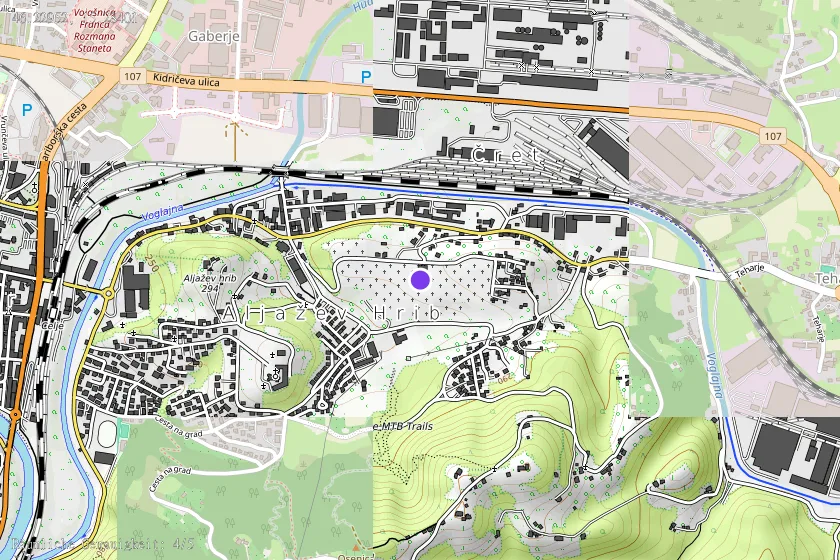
Mestno pokopališče Celje, desno od poslovilnih vežic po poti, ki ob spomeniku prisilno mobiliziranim v nemško vojsko vodi vzdolž pokopališča, 2. grob desno od poti v 2. vrsti.