PoH-Code: poh.19019
Cyclostyle technique
—
partizanstvo.si / Arhiv Geopedia · CC-BY 4.0 (privzeta licenca) · Preneseno iz Geopedije.
In the year 1934, the cyclostyling technique was used at Pavle Zibelnik's place, where the Red Banner, the newspaper of the Central Committee of the Communist Party of Yugoslavia (CK KPJ), was reproduced. The technique was published in April 1934.
Zibelnik and his collaborator Stane Mrhar were arrested and sentenced to prison terms.
Source: Guide through partisan trails, Ljubljana: Borec, 1978, p. 53.
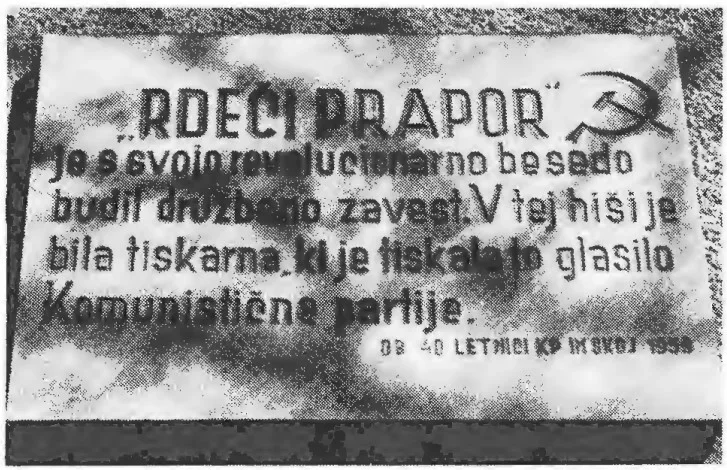
The memorial plaque dedicated to the printing house of the Red Banner, erected on the façade of the building at Zapuški cesti st. 23, was unveiled on the 40th anniversary of the establishment of the Communist Party of Yugoslavia (KPJ) and the Slovenian Communist Youth Organization (SKOJ) on 22 July 1959.
Up to 1932, the party organization in Slovenia was partially restored. It began to gain increasing influence among the working class. At the same time, a strong illegal technique was also established. The party, in addition to various leaflets, began to issue its own illegal newspaper, the Red Banner. The newspaper was published in Ljubljana from March 1932 to August 1934, with Boris Kidrič as its editor. The newspaper, with its 4.49 critical analyses of the activities of the Slovenian party, greatly contributed to the popularization of the party among the masses and to the struggle against sectarianism within the organization. During its publication period, it played an important role in the process of restoring the KPJ in Slovenia. In 1934, the Red Banner was reproduced using the illegal cyclostyling technique at Pavle Zibelnik's place in Zapuži. There, three issues of the newspaper (no. 1 – March, no. 2 – May, no. 3 – July) and a special edition (August), which was published during the miners' hunger strike in Trbovlje, were printed. The technique was uncovered in November 1934 due to its illegal nature. Pavle Zibelnik and his collaborator Slane Mrhar from Šentvid were arrested and sentenced to prison terms; the technique then moved to Hinko Smrekar in Brejčevska ulica in Siško, where it operated for the following year.
Memory is power, Ljubljana:
OK SZDL Ljubljana-Šiška, 1985, p. 48–49.
- 2022: The residents say that during the renovation of the façade in the 1980s, they tried to remove the plaque, but it was so badly damaged that they could not reinstall it.
Translation · AI tier 5
Sources
- Partizanstvo.si — Partizanski spomeniki (#7353) (dc4e8719-8147-4918-9b67-926f49e15265) — Partizanstvo.si — Partizanski spomeniki (#7353)
Links
Location & map
Map position available (Point) · spatial accuracy: 4 — Accurate
Textual location description
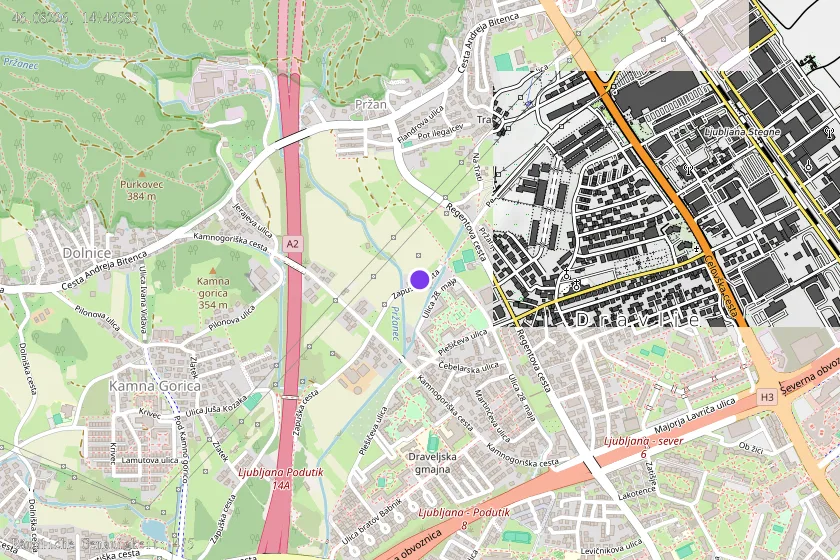
Zapuška cesta 23.