PoH-Code: poh.25906
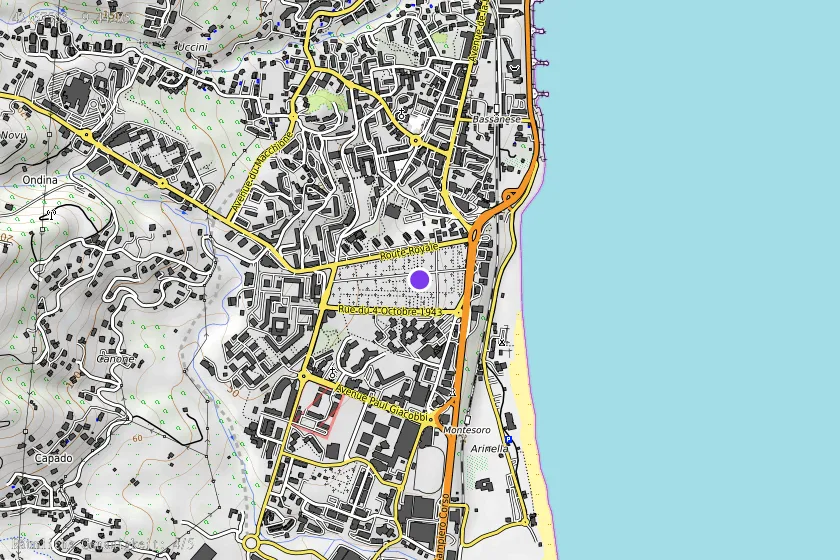
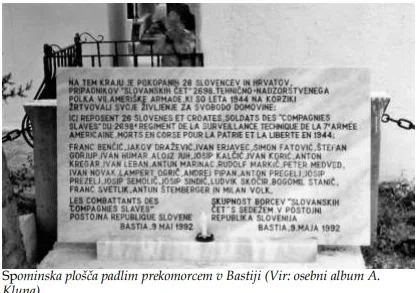
Bastija, Memorial to the Deceased Primorski and Croats, Korzika
—
partizanstvo.si / Arhiv Geopedia · CC-BY 4.0 (privzeta licenca) · Preneseno iz Geopedije.
After the Allied occupation of southern Italy, Badoglio's government began offering its armed forces to the Allies, so that they could take part in battles against the Germans, who had opened a new front in central Italy.
On Sardinia, Sicily and in northern Africa, there were around 30,000 Slovenes and Croats from Istria, Istria, Venice and Istria, who had come there as soldiers of the Italian fascist army and, upon Italy's capitulation, joined Badoglio's army. In the majority, they wished to join the NOVJ. Numerous resolutions were passed on this intention, on the question of repatriation of Slovenes and Croats, Italian citizens, and the issue was also discussed on meetings between Marshal Tito and General H.M. Wilson, and later on a meeting between Tito and Winston Churchill on 12th and 13th August 1944. The latter generally agreed to their inclusion in the NOVJ, but from operational reasons, it would not be possible to resolve the obligations of those who had already been moved from Sardinia to Corsica.
In February 1944, the Allies recruited almost 6,000 members of special labour battalions and moved them to Corsica over the next three months, while around 2,000 remained on Sardinia. The first battalion, the 354th, left for Corsica on 14th February 1944, followed by the 26th. These had between 111 and 225 men. On 1st February 1945, there were 4,741 Slovene and Croatian members of special battalions on Corsica. The initiators of the relocation were Italian officers, due to the belief that units were gathering in the Yugoslav base in Bari and preparing to depart overseas brigades to Yugoslavia. Italian officers also went to Corsica, but the soldiers refused to obey them and they were sent back to Sardinia.
After the relocation to Corsica, members of special battalions were included in the VII. American Army, the Northern Base Section (Northern Base Section, NORBS), commanded by General J. P. Ratay, initially in the 2615th, and later in the 2698th Technical Supervisor Regiment. The task of units on Corsica, including the special labour battalions, was the preparation for the invasion of southern France. NORBS was responsible for repairing roads, harbours, airfields, depots, barracks, telecommunications and transport, for guarding military objects and camps of military prisoners, checkpoints, engineering, supply and other special battalions for loading bombs on aircraft. The battalions were dressed in American uniforms, formed according to the system of the American army and assigned their own officers and non-commissioned officers. These officers and non-commissioned officers often treated the Slovenes and Croats cruelly. Their living conditions also improved, and they received payment for their work. Initially, they were fed equally to the Americans, but later food was rationed. Officers had personal weapons and wore special insignia. Two battalions were guard battalions, they had weapons and guarded depots, camps of military prisoners and partially controlled traffic. The American command initially allowed them to wear badges with the Yugoslav flag and the five-pointed star and to display the Yugoslav flag with the star, but in May 1944 they also forbade this. Officially, they were called «Slav Companies», that is «Slovene battalions». The name Yugoslav was retained on the cemeteries, where members of Slovene battalions, who were mostly killed by firearms and explosives, were buried.By November 30, 1944, 30 Primorski and Istrian civilians had died on the Koper coast, of these only two died in hospital (poisoning and malaria), all the others perished primarily during the transportation of ammunition. In one larger incident at the location of Biguli, a truck carrying ammunition exploded in the air. Six deceased were buried in a common grave (Anton Marinac, Simon Fatovič, Ivan Korič, Peter Medved, Ludvik Skočir and Anton Stemberger)
Source: S. Vilhar and A. Klun, First and Second Transalpine Brigade, Nova Gorica, 1967
Source-photo: M. Ivančič, Transalpines, stories about the odyssey of Primorski and Istrian civilians, Koper, 2023
Source: N. Troha, Slovenes and Croats in "Slavic detachments" on Sardinia, Koper coast and southern France (1944-1945), Contributions to Contemporary History XLVI-1/2006
Keyword: transalpines123
Translation · AI tier 5
Sources
- Partizanstvo.si — Partizanski spomeniki (#8731) (3fe90973-b674-48c1-9c06-190cc37c7fc7) — Partizanstvo.si — Partizanski spomeniki (#8731)
Links
Location & map
Map position available (Point) · spatial accuracy: 4 — Accurate