PoH-Code: poh.21419
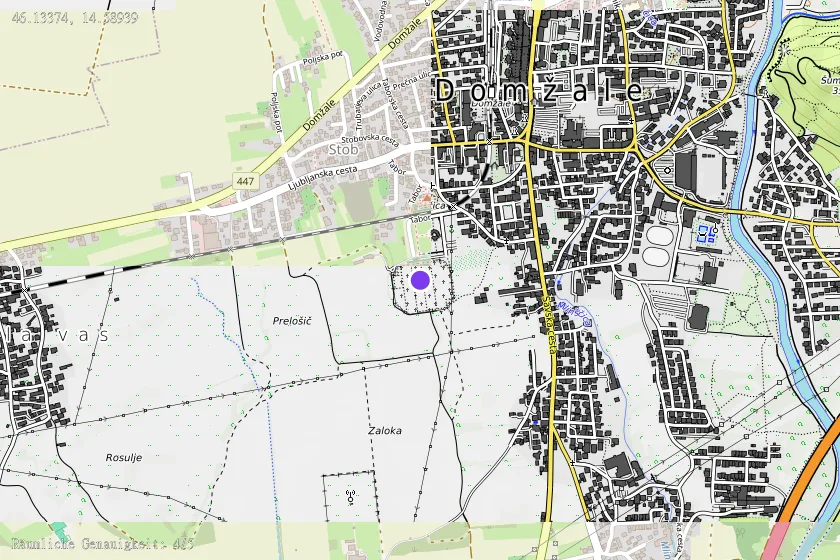
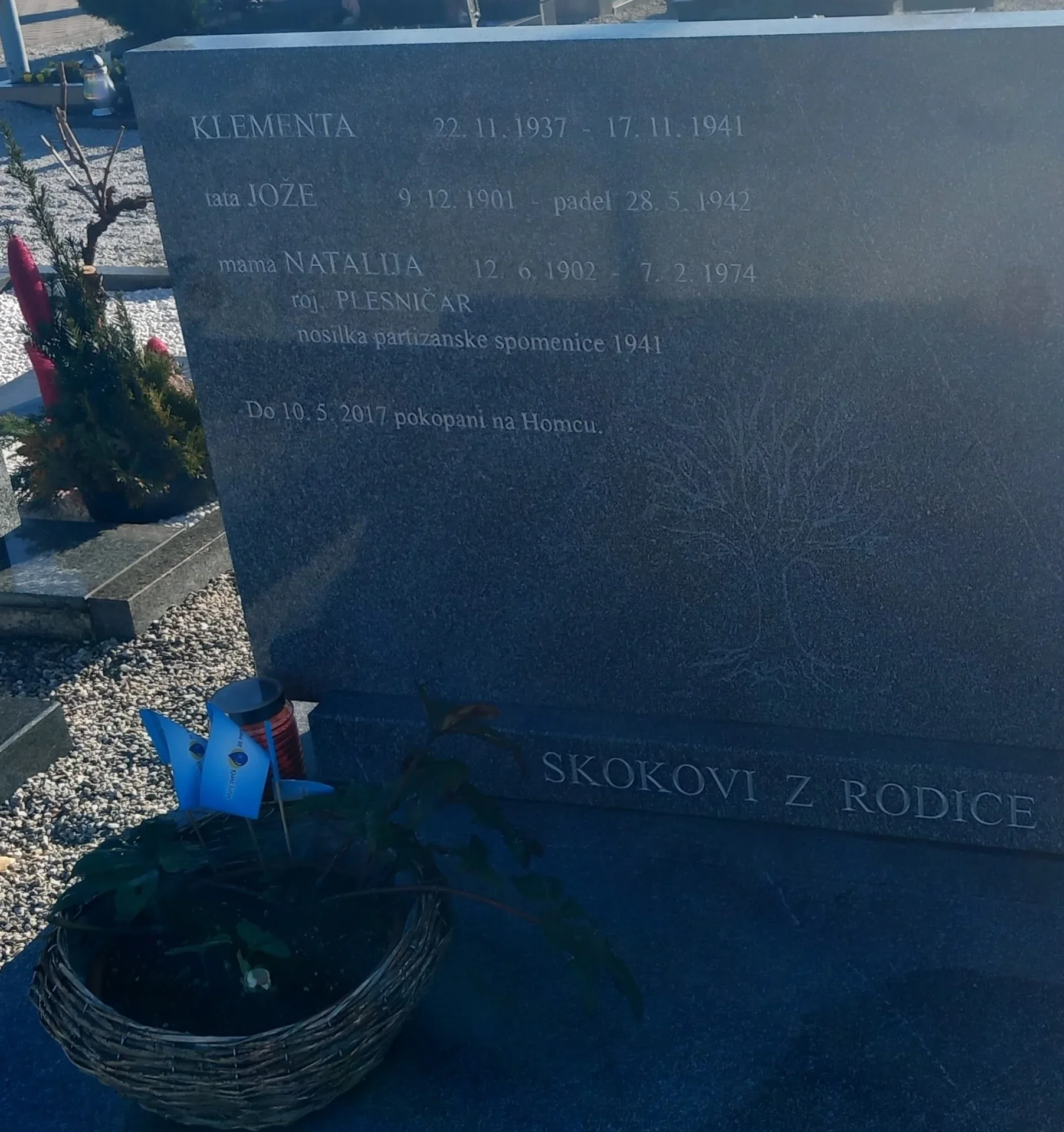
Domžale, Cemetery, Skok Jože and Natalija
—
partizanstvo.si / Arhiv Geopedia · CC-BY 4.0 (privzeta licenca) · Preneseno iz Geopedije.
Jože Skok: Sistory
states: First and last name: Jože Skok, Father: Jožef, Mother: Barbara, Date of birth: 09. 12. 1901, Place of birth: Ravnica, Place of residence: Rodica, Old municipality: Homec, New municipality: Domžale, Occupation (social status): worker, Date of death/disappearance: 28. 05. 1942, Place of death/disappearance: Rodica, Country of burial: Slovenia.
»In May 1942, a terrible misfortune struck our family. Because of betrayal, we lost our father, my husband. A railway worker from Rodica maintained contact with Jesenice. In a state of drunkenness, he confessed that Mira Tomšič was hiding at our place and at Bevka. My husband had seen Mira Tomšič at Bevka. On the 27th or 28th of May, the Gestapo from Jesenice, who was searching for Mira Tomšič, arrived in the evening at 8 o'clock to arrest Bevka, and at half past twelve, my husband. First, they knocked on the window, and then they started breaking down the door and demanded that we open it. The husband quickly got up. Even as he was on the corridor, he coldly thought about how to escape. Finally, he opened the door. The Germans rushed into the house and quickly checked if anyone else was inside besides the family. The husband ran towards the back door to escape, but at the threshold, he was shot by a burst of fire. The first burst of fire barely missed the youngest child, who was barely two years old and had just risen from his crib. The husband was laid on the bed. He received a bullet in the chest. The Germans left to get a doctor. I went to call my brother. He and my husband Vide Plesničar went to get Dr. Kremžar. The Germans, who had returned soon after, also brought a doctor named Pirihar. He gave the husband an injection to make him conscious. Then the Gestapo began to question him. They asked him about his relationship with his lover Metka-Mira Tomšič, where they met, and where Metka was now. The Germans expelled Dr. Kremžar. Then they left. The husband quickly sent for Žabnikar. Together, they guessed who might have betrayed him, but they could not find out. At that moment, the Germans came again. While they were searching the house, Metoda Žabnikar managed to quietly escape from the house. Then a rescue car arrived. When they tried to take the husband away in it, he resisted. At that moment, he started to bleed. He collapsed on the bed and began to die. The Germans left, but the husband managed to gather enough strength to say goodbye to all of us. He comforted himself and us, saying, since you were never used to good things, you would survive. That night, the body turned completely pale. When he breathed his last, I went to call the neighbors, but no one dared come to help us with the husband's body. All night we gathered around the dead body until it was light. Then I went to Rodet and asked him to bring the coffin. My brother went to the priest in Mengeš to have the husband buried, but he was not at home. Later, a boy from the Home for the Disabled came to tell us that the Gestapo had forbidden the priest to perform a church burial for the husband. We buried him next to the grave of our four-year-old daughter, who had already died before.«
(Statement by Natalija Skok
Rodica near Domžale, 1957, in: Stana Gerk, Ivka Križnar, Štefanija Ravnikar-Podbevšek [ur.], Under the Terror of the Kamniški Gestapo, Slovenes in the National Liberation War, I, Collection of Documents, Articles and Memoirs, Ljubljana: Zavod Borec, 1970, 432)»Due to numerous arrests of party members and activists of OF, in May 1942 Metka lost contact with the regional committee. Her difficulties were reported to Lojze Bevk [..] Bevk wrote to this railwayman in Jesenice via regular mail, informing him that Metka was seeking contact [..] There was no response, but on 28 May 1942, two Gestapo officers arrived from Jesenice in two cars. [..] The car with the Gestapo officers in civilian clothes turned towards Bevk’s house, which Schubert showed them, while the car with the uniformed Gestapo officers went to the house of Jože Skok on Jarše. Lojze Bevk was the secretary of the OF organization in the paper mill and on the field, while Jože Skok was in the factory Induplat in Jarše and also on the field. Both were closely collaborating and both had connections with Tomo Brejc and Miro Svetina-Metka (who at that time was still not yet known as Svetina). This was the reason why the Gestapo attacked these two connections simultaneously, because in any way they wanted to capture Metka and thus earn some praise, if not even an award.
At Skok’s house, everyone was already asleep when the car stopped near the house. The first Gestapo officer continuously fired through the window into the room, while the second one knocked on the door and called out, telling them to open. While Skok was getting dressed, his wife and children begged the Gestapo officers to let his husband or father stay at home. Skok took advantage of this and ran towards the door, where the automatic rifle shot him, causing him to fall over the threshold. The Gestapo quickly realized they had overstepped. They ordered the family not to let anyone leave the house, because they would return with a doctor. Two doctors arrived: one was sent by Skok’s children, the other was called by the Gest, and arrived with a rescuer. The Gestapo wanted the doctors to at least prolong his life a little so that they could interrogate him. While they prepared the stretcher, Jože Skok died on his bed, from which blood was dripping.«
(Tone Svetina, Night in the Hotel Park, Ljubljana: Založba Borec, 1987, p. 308, 309)
»In 1943 the organization of OF expanded significantly. Work became more collective. In the spring an organization of SPŽZ was established in our area. I was connected to this organization by comrade Ivanka Bevk-Mica. [..] Our house was a storage place for the regional youth committee, because the daughter of Boža worked along the youth line. [..] On 22 March 1944 I was arrested. [..] That is why I breathed a sigh of relief when we were taken by our sister to the Gestapo in Kamnik. [..] The interrogation was very harsh. [..] On the same day we arrived in Begunje with our sister, a group of women from Jesenice who supported the partisans were tried. Our transport left Begunje for Ravensbrück on 24 April. [..] The camp was evacuated on 30 April 1945 due to the advance of the Red Army. We walked all night and the next day. [..] We came across Slovenian military prisoners who helped us, making it easier for us to find our way home. I returned home after a month, arriving only on 1 September.«
(Statement of Natalija Skok, Rodica near Domžale, 1957, in: Stana Gerk, Ivka Križnar, Štefanija Ravnikar-Podbevšek [ur.], Under the Terror of the Kamniški Gestapo, Slovenes in the National Liberation War, I, Collection of Documents, Articles and Memories, Ljubljana: Zavod Borec, 1970, 433, 434, 435)
»1376 Skok Antona Natalija, born 13. 6. 1902, Ravnica, Gorica, lady of Rodica near Kamnik«
(Janez J. Švajncer, Partizanska spomenica 1941: List of Bearers, Published in Commemoration of the 20th Anniversary of the Operation of the Military Museum of Logatec, Logatec: Military Museum of Logatec, 2017, p. 176)Note: The information about the date of birth is
on the gravestone different (12.) compared to the book Partizanska spomenica 1941 (13.)
Translation · AI tier 5
Sources
- Partizanstvo.si — Partizanski spomeniki (#9406) (d4a48bc8-0897-4846-9f14-34ce2737cfb7) — Partizanstvo.si — Partizanski spomeniki (#9406)
Links
Location & map
Map position available (Point) · spatial accuracy: 4 — Accurate
Textual location description
Pokopališče Domžale, P:C, V:07, S:9/1 Iskalnik grobov Domžale ne vrne zadetka.