
PoH-Code: poh.23588
Grave of National Heroes, Niš
—
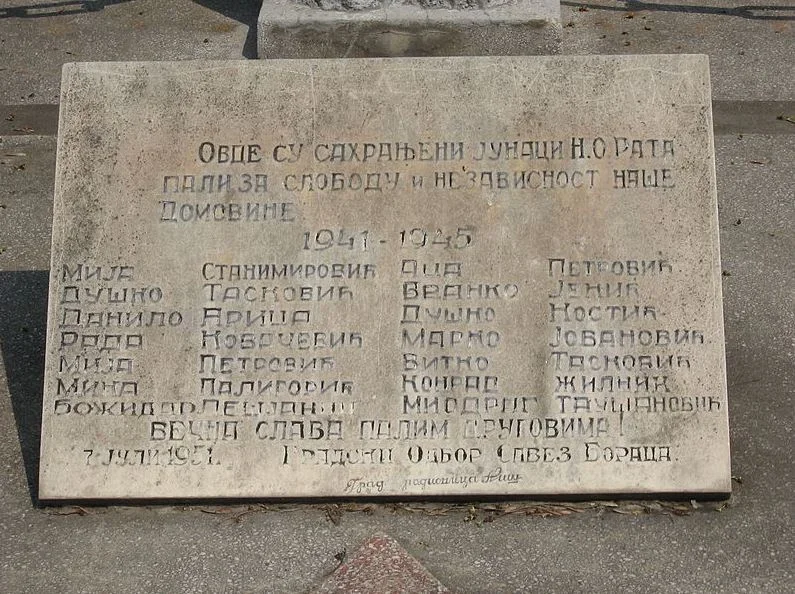
partizanstvo.si / Arhiv Geopedia · CC-BY 4.0 (privzeta licenca) · Preneseno iz Geopedije.
Memorial for the fallen fighters-grave, without a commemorative monument, was built in 1945 on the first anniversary of the liberation of Niš on 14 October. For the final rest, the remains of 12 fighters were laid to rest. On the tenth anniversary of the uprising in Serbia, 7 July 1951, the final appearance of the grave was constructed, and at that time the remains of the national hero Konrad Žilnik and the first fighter Miodrag Taušanović were added. Taking into account the fighters buried at this place, the grave represents a document of the struggle for freedom and the bravery of this area. Here, the revolutionary spirit has always prevailed, and people have always responded to the call for freedom. The monument also has a broader meaning, as among the buried are also fighters from other republics. In addition to the national heroes, eight first fighters and four members of the SKOJ are buried. The monument consists of a basic concrete slab bounded by eight pillars, interconnected by a chain. In the center of the plateau is a concrete five-pointed star, and above it is a horizontally placed white marble slab (85 x 60 cm) with an inscription.
Konrad Žilnik, together with his father Viktor, who was a tailor, from Kaple near Žalce, came in search of work in 1937 to Niš, where he was employed in a military tailoring workshop. As a seventeen-year-old, he learned the trade of a tailor and then worked in a wool mill, and then went to serve his military service. Upon his return, the country had already collapsed. He became an important member of the CP and participated in organizing resistance. He participated in the establishment of the thermal and Ozren partisan detachment (in 1942, deputy commander, then in 1943 commander), leading it in numerous actions (attack on the weapons post in the village of Ražanj, in battles with the Chetniks in Popšica, Pirkovac, in Belem Potok and on Crem Hill, as well as numerous sabotage actions such as disabling the coal mine in Sokobanja and an attempt to assassinate the local head in Knjaževac). From the establishment of the Timoš battalion (October 1943), he was no longer a commander, but an organizer of new partisan units and political work on the ground. At the beginning of 1944, together with his comrades, he went to the area of Pirota due to the mobilization of new fighters and assistance in the work of the NOO. After completing the work, he and his comrades were surrounded and captured by the Chetniks on 27 February in the settlement of Pajež. They took him to the settlement of Kozje near the White Church, where they tortured him for a few days and finally beheaded him.
Source: Interview with Želimir Žilnik, Jutranji list, 21 December 2009
Slovenian Biographical Lexicon, Metka Gombač
photo: si.wikipedia
herojgrob123
Translation · AI tier 7
Sources
- Partizanstvo.si — Partizanski spomeniki (#7808) (f892cdfe-9a68-4963-a90f-6b6c3f23ceda) — Partizanstvo.si — Partizanski spomeniki (#7808)
Links
Location & map
Map position available (Point) · spatial accuracy: 4 — Accurate
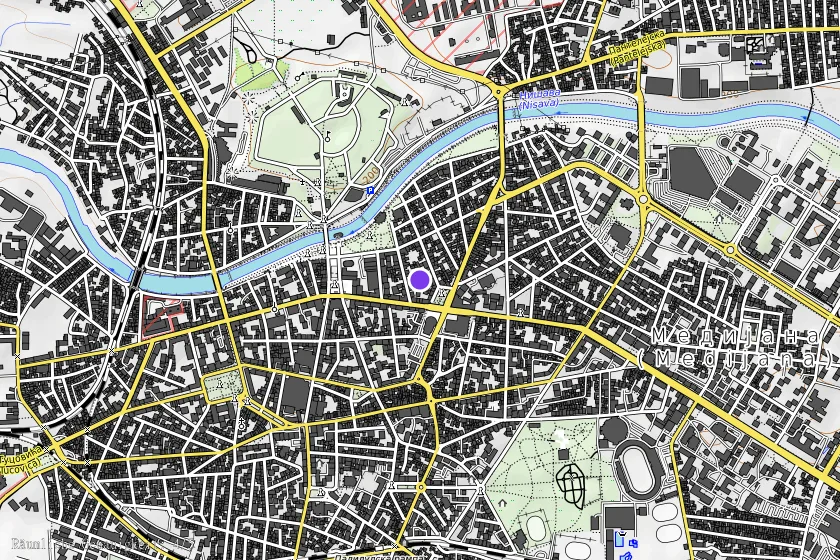
Coordinates (WGS84)43.32143° N, 21.89940° E