
PoH-Code: poh.27879
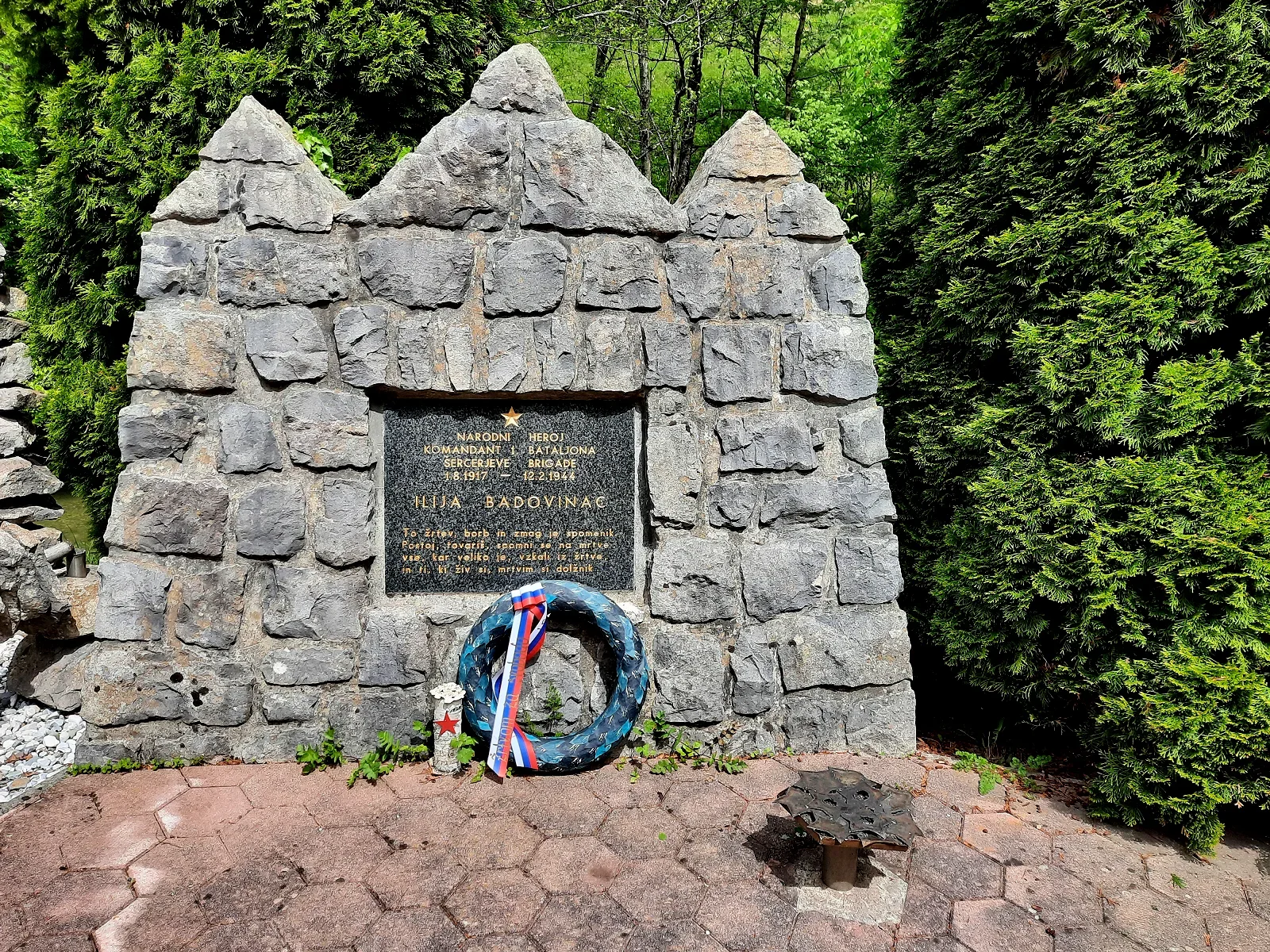
Gračnica, grave of Ilija Badovinč
—
partizanstvo.si / Arhiv Geopedia · CC-BY 4.0 (privzeta licenca) · Preneseno iz Geopedije.
The memorial is built from stone, bound with concrete, and shaped similarly to the well-known partisan shelter ''triglavka''.
Ilija Badovinac
He was born on 1 August 1917 in Rosalnice in Bela krajina and completed his primary school in Metlika. His military service was with the royal guards in Belgrade and he was awarded the rank of lieutenant. Upon returning home, he entered politics and joined the communist camp. He became a member of the KPS in spring 1942. In the same year, namely on 20 May, he joined the national liberation struggle. He initially belonged to the 2nd Belokranjska unit, from which the Belokranjski detachment was formed in June 1942. With this detachment he participated in many battles in Dolenjska, and rose in rank within the detachment; in July 1942 he became deputy political commissar of the detachment and upon its reorganisation, he became commander of the first battalion of the West Dolenjska detachment. At the end of December 1942 he became commander of the 3rd battalion in the Cankarjeva brigade and proved himself in battles in January and February 1943, when his battalion, together with Croatian partisans in Žumberk, destroyed several Italian outposts. He also participated in battles at Žužemberk between 25 and 28 July 1943. At the end of September 1943 he was appointed deputy commander of the 12th Slovene national liberation brigade which was mainly composed of Šlandrove and Gubčeve brigades. With the latter Badovinac fought among other things during the German offensive in autumn 1943 and during the siege of Novo mesto in November of the same year. In this month his final transfer took place – to the 14th division, where he was initially an operational officer in the staff of the 2nd battalion of Tomšičeva brigade and later in January 1944 became commander of the 1st battalion of Šercerjeva brigade. This battalion served as a vanguard for the 14th division (a vanguard is a military unit that guards the front of a larger military unit during marches). During the battles of the 14th division against the Germans in Styria, on 12 February 1944, he protected the division while crossing the bridge over the Gračnica stream on the Gračnica–Vodiško road and fell in combat with the German vanguard. His body was found by the Germans and he was buried at the site of his memorial.
Ilija Badovinac was proclaimed a national hero on 20 December 1951.
On the opposite side of the road there are three types of steps (seats) with inscriptions Šercerjeva, Bračičeva, Tomšičeva.
Sources:
Andreja Rakovec, Badovinac, Ilija (1917–1944). In: Slovenska biografija, Slovenska akademija znanosti in umetnosti, Znanstvenoraziskovalni center SAZU, 2013. Available at: http://www.slovenska-biografija.si/oseba/sbi1016610/#novi-slovenski-biografski-leksikon
Monuments of our revolution, Ljubljana: Mladinska knjiga, 1961, p. 193.
EŠD 26352
Sources of images:
Source of the photograph of Badovinčev grave in 1966, when the memorial Živi zid had not yet been built, is from the book by Pavl Baloha: Po poteh revolucije; Reminiscences of pre-war revolutionary work in Trbovlje and the national liberation struggle 1941–1945, p. 251.
Keyword: herojgrob1234
Keyword: herojsmrt123
Translation · AI tier 5
Sources
- Partizanstvo.si — Partizanski spomeniki (#774) (cd3a34bf-0c0b-4641-9ce0-4213a62b8092) — Partizanstvo.si — Partizanski spomeniki (#774)
Links
Location & map
Map position available (Point) · spatial accuracy: 4 — Accurate
Textual location description
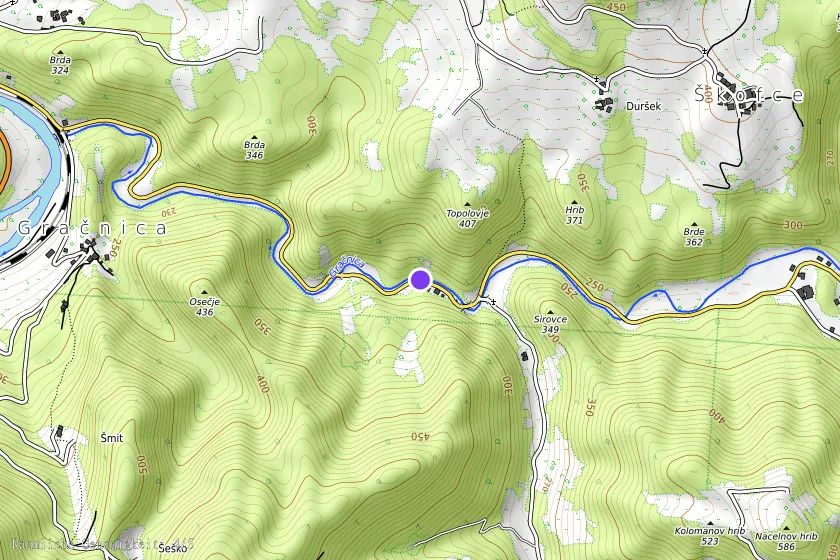
Spomenik stoji ob cesti Gračnica – Vodiško, torej tam, kjer je Ilija Badovinac padel in je pokopan.
Coordinates (WGS84)46.10680° N, 15.23703° E