
PoH-Code: poh.26091
Goriče - central memorial to fallen soldiers and civilians
—
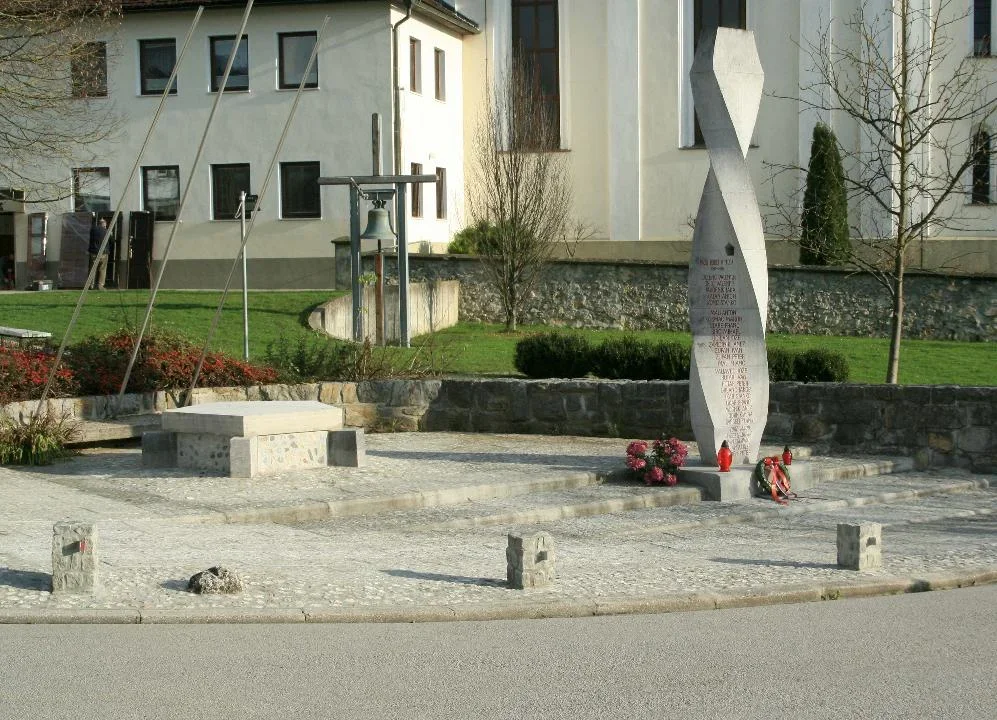
partizanstvo.si / Arhiv Geopedia · CC-BY 4.0 (privzeta licenca) · Preneseno iz Geopedije.
DESCRIPTION OF THE MONUMENT: A cube in the shape of a spiral (height 460 cm, diameter 87 cm) illustrates the change in the social order after the victory of the revolution. The monument is dedicated to the fallen fighters and civilians from the areas that belonged to the former municipality of Goriče (Babni vrt, Čadovlje, Golnik, Goriče, Letence, Kamnjek, Zavode, Pangeršica, Povlje, Srednja vas, Tenetiše, Trstenik, Zalog, Svarje and Žablje). The names of the fallen fighters are engraved on the front face, and the names of the shot civilians – locals – are engraved on the back face.
The plans for the monument and its surroundings were made by the architect Edvard Ravnikar. The monument, erected by the local committee of ZB NOV Goriče, was unveiled on 28 June 1953 by the then president of MLO Kranj and the former commissioner of the Gorenjska detachment, Vinko Hafner.
DESCRIPTION OF THE EVENT: In the areas that belonged to the former municipality of Goriče, people mainly survived before the war through farming, livestock breeding, fruit growing, and partially through forestry. Therefore, the inhabitants lived mainly under the influence of the ruling bourgeois parties. However, the position and mindset began to change only with the development of industry in Kranj and nearby Tržič. Even the construction of new buildings for the Golnik sanatorium provided many locals with work. Thus, for the first time in the municipality of Goriče, a new layer appeared – workers. Workers also came from elsewhere, especially from Primorska. These people had already gone through the hell of fascist persecution and therefore found refuge in our areas. As people who were nationally conscious and forward-thinking, they brought this spirit even to the area of Goriče. The same progressive mindset also began to arrive in these areas through workers who were employed in Kranj and Tržič.
And thus, the great time of the national liberation struggle found the locals of Goriče and the surrounding areas prepared. The blood tax was exceptionally high in these mountainous areas: 26 locals fell in battle, and 23 were shot as civilians or died in internment camps.
Among the most active in the struggle for the redirection of the local mindset in Goriče, one must mention Oskar Peršolj, who came to Yugoslavia from the Goriška Brda (Kojsko) already in 1936. He joined the partisans in the spring of 1942 and participated in the well-known battle in Udin borštu on 14 September 1942. At that time, the Germans captured him. They sent him to the Mauthausen internment camp, and on 21 April 1943 he succumbed to torture.
Among the locals, the most important activist was Stanko Konc – Kos. By profession, he was a tailoring assistant and was already very active in the Drlavsko enlightenment society Svoboda (later Vzajemnost) in Kranj before the occupation. He joined the partisans at the beginning of 1942 and immediately took on various political and military functions. In the fight against the Gestapo and local informers, he was shot on 14 February 1944 just above Zalog.
SOURCES: Memorials of the National Liberation Struggle in the Municipality of Kranj, pp. 84–85; Vodnik po partizanskih poteh, Ljubljana: Borec, 1978, p. 227; Data on monuments and memorials in the area of KO ZB NOV Goriče, which with its activities covers KS Golnik, Goriče, Tenetiše and Trstenik
EŠD 29198, memorial heritage
Translation · AI tier 7
Sources
- Partizanstvo.si — Partizanski spomeniki (#336) (998e92a2-a308-4abb-b4e3-8edf94383d71) — Partizanstvo.si — Partizanski spomeniki (#336)
Links
Location & map
Map position available (Point) · spatial accuracy: 4 — Accurate
Textual location description
Spomenik stoji sredi Gorič, na ovinku ceste, ki vodi proti Golniku (blizu cerkve). Hiša v bližini: Goriče 27
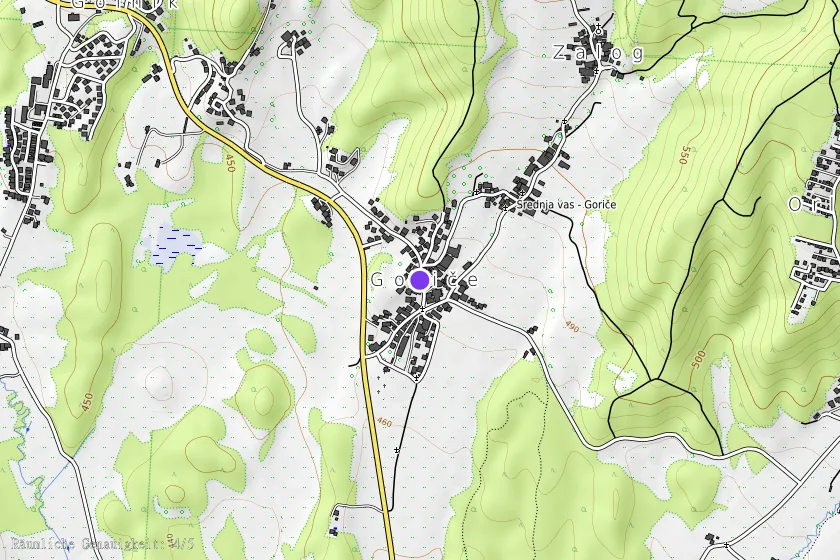
Coordinates (WGS84)46.31903° N, 14.34578° E