
PoH-Code: poh.24301
Hrpelje - Dragomir Benčič - Brkin
—
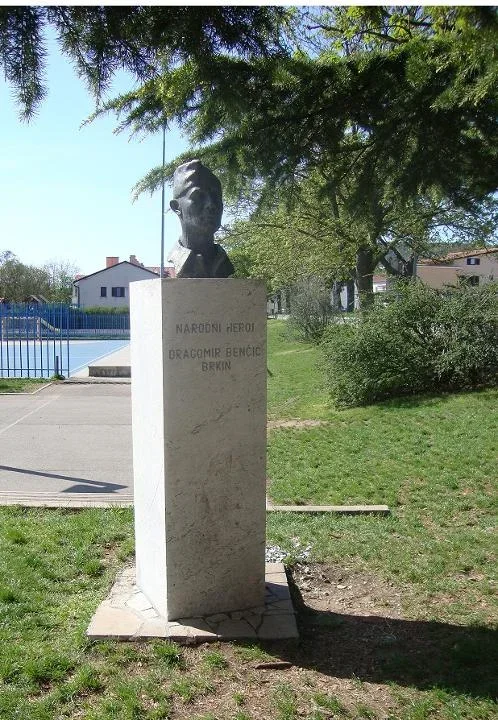
partizanstvo.si / Arhiv Geopedia · CC-BY 4.0 (privzeta licenca) · Preneseno iz Geopedije.
Monument, erected on a stone pedestal. Unveiled on 25. 11. 1967, sculptor France Rotar.
EŠD 16831
.
BENČIČ, Dragomir (Dragomir Benčić, partisan name Brkin), partisan, political commissar, generalmajor, national hero (born 30. 10. 1911, Pulj, Croatia; died 23. 6. 1967, Zagreb, Croatia, buried in Ljubljana).
He attended primary school in Pulj, and secondary school in Ljubljana (graduated in 1930), where his family had fled from fascism. From 1930, he studied civil engineering at the Faculty of Engineering in Ljubljana, but due to harsher social conditions, he frequently interrupted his studies and survived as a technician. He completed his civil engineering studies in 1950 at the Faculty of Engineering in Zagreb, and in 1956 he graduated from the Higher Military Academy in Belgrade.
Before the Second World War, he joined the progressive student movement in Ljubljana. In April 1941, he joined the national liberation movement as a volunteer, was immediately arrested, but managed to escape from Ljubljana. He helped in organizing the first partisan units, collected weapons and necessary supplies, and distributed propaganda material. In April 1942, he joined the NOB and became a member of the KP. He joined the 1st unit of the Internal Security Directorate as a political commissar, and in July 1942 he joined the newly established Dolomitski Directorate, where he became the political commissar of the II. Battalion. He also took over the position of political commissar in the III. Battalion of the Šercerjeva Brigade (1942–43), 1st Istrian Brigade (1943), 3rd Battalion of the Loška Brigade, 13th Slovene Shock Brigade, later named Bračičeva Brigade (1943–44), IV. Operational Zone (1944–45), 14th Division (1944–45), and 9th Corps (1945 until incorporation into the Yugoslav Army). As political commissar of the IV. Operational Zone, in 1944 he issued a circular calling for more intensive political work within partisan units, highlighting Slovenia's rights to Carinthia, Slovene Coast, Benečija and Istria; for the popularization of the Red Army, he recommended the content of Tito's speech upon the arrival of the army in Yugoslavia; his last demand was that a sharper stance be taken towards Vermans, domobranci and others, who despite the call, did not wish to leave the occupiers' ranks until a certain date, i.e. September 1944. He demanded the handover of prisoners to military courts, and more lenient treatment for those who surrendered themselves to the partisans. As a political commissar, he contributed to the strengthening of resistance in Istria, Styria and Carinthia. He participated in several major battles, such as in Jelenov žleb, on Pohorje, in Mozirski Mountains, and in all battles during the advance of the XIV. Division to Styria. During the war, he was wounded three times. As a commissar of the 9th Corps, he led the 30th and 31st Divisions, which liberated Trieste in April 1945. In 1945, he became a member of the Central Committee of the OS Slovenia.
Source: Novi Slovenian Biographical Lexicon
Translation · AI tier 5
Sources
- Partizanstvo.si — Partizanski spomeniki (#3034) (94ef4baa-0a3c-4b37-a492-ab878153027b) — Partizanstvo.si — Partizanski spomeniki (#3034)
Links
Location & map
Map position available (Point) · spatial accuracy: 4 — Accurate
Textual location description
Kip je postavljen pred osnovno šolo v Hrpeljah (Hrpelje, Reška csta 30).
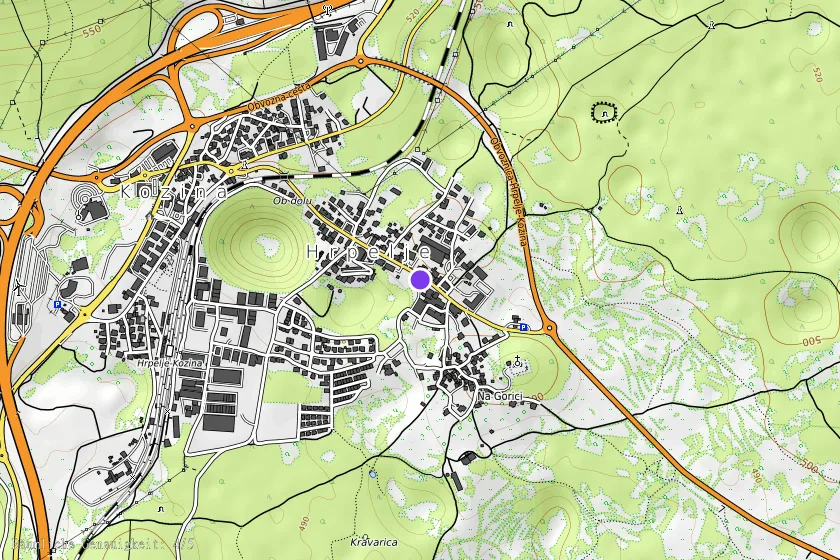
Coordinates (WGS84)45.60585° N, 13.94591° E