
PoH-Code: poh.17052
GROSUPLJE-Ana Gale
—
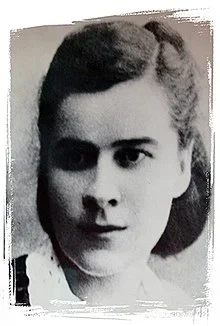
partizanstvo.si / Arhiv Geopedia · CC-BY 4.0 (privzeta licenca) · Preneseno iz Geopedije.
On the wall of the old cemetery near the church in Grosupljе, Ana Gale is buried in a family grave. A stone inscription on her tombstone and a memorial plaque at the site of the former Tovarne motvoz and textile factory in Grosupljе commemorate her. Her memory also lives on in many poems, which are recited at memorial celebrations before the Grosupljе monuments. A school, OŠ Št. Jurij near Grosupljе, was also named after her, though it was renamed in the independent state. The school OŠ Ana Gale in Sevnice is still named after her.
She was the fifth child of Franček and Frančiška. As a child, she lived with her brothers and sisters in Grosupljе. Until 1921, she lived with her uncle and aunt in Ljubljana. She attended a private girls' eight-grade school, a real gymnasium, and the Music School. In Kočevje, she attended the second and third grades of the girls' municipal school, while living in a monastic boarding school during her studies. From 1924 to 1928, she traveled daily from Grosupljе to the Ljubljana teacher training school, without having any school books.
After graduating in spring 1928, she was employed as a teacher, although she was also interested in studying. Initially, she volunteered to teach at OŠ Grosuplje (1928–29). By 1936, she was teaching at the school in Št. Jurij, three years in Leskovac near Krškе and at the department for children with disabilities in Sevnice, where she was transferred in 1939. She became a recognized educator – her appearance in the magazine Slovenski učitelj was noted as masterful. In 1973, an independent school with a tailored program for children with special needs was established there, named after her (Osnovna šola Ane Gale).
During World War II, she had to move back to Grosupljе and became an "empty-handed refugee". Soon after, she was employed at a textile factory, which, according to Radka Polič, was the most important human and organizational base of the liberation movement at that time. From 1943, she worked as a field worker in the OF and as an activist in AFŽ. After the fall of fascist Italy, the homefront fighters interrogated Ana several times and even imprisoned her in 1943. On 4 January 1944, she was arrested and four days later killed in the nearby forest, left unburied. On 15 June 1944, her body was respectfully buried in Grosupljе.
In the last days of her life, she collected her poems and arranged them into three unpublished collections: Risa (1941), Šopek (lost) and Predica (1943). She also wrote a story, which she was unable to complete. Her poems from the 1930s were arranged as: 1) Published poems. Vzdihi, 2) Captivity, rejected, yet my most beloved, and 3) Occasional poems or Raglje. In 1971, her poems were collected and divided into three sections by Milan Dolgan: 1) In Exile. Risa: war, partisan, and love poems. The latter were intended for her partisan love, Risa. 2) Predica: poems that were written while she worked at the factory. 3) Šopek: poems before the war, where love and domestic themes prevailed. In 2010, an illustrated book Skozi našo vas was published, which she had prepared for printing, but the collection was released long after her death. Her handwritten manuscripts are kept in the Valvasorjeva Library in Krškе.
Ana Gale. Sistory
Ana Gale. Wikipedija
Translation · AI tier 5
Sources
- Partizanstvo.si — Partizanski spomeniki (#7074) (26e001e8-6d05-4769-b8cc-c1433e793664) — Partizanstvo.si — Partizanski spomeniki (#7074)
Links
Location & map
Map position available (Point) · spatial accuracy: 4 — Accurate
Textual location description
Z zidom starega pokopališča nasproti farovža, Hribska pot 6, 1290 Grosuplje, Slovenija
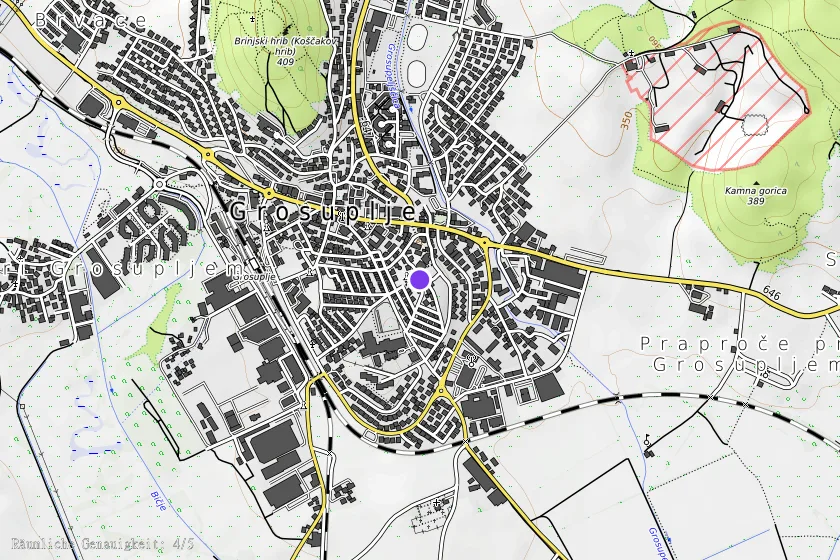
Coordinates (WGS84)45.95503° N, 14.65966° E