PoH-Code: poh.10400
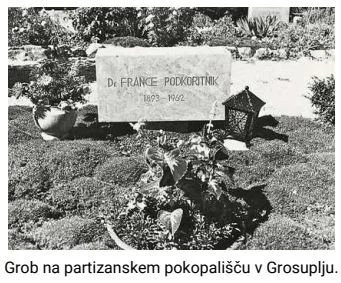
Dr. France Podkoritnik, partisan cemetery, Grosuplje
—
D. Divjak · CC-BY-4.0 · partizanstvo.si
September 1933, Dr. Franc Podkoritnik from Veljva was voluntarily transferred to Grosuplje, where he served as an insurance medical officer for workers and a private physician until the beginning of World War II. He often visited patients at home. Patients were mostly farmers arriving with wagons, tractors, and motorcycles, in the mornings, afternoons, and evenings.
In Grosuplje, he joined Sokolsko and Gristol associations and actively participated in the Red Cross. In 1935, he became one of the six mayors and led various types of Sokol activities until the start of World War II. His wife, Vera, also actively engaged as a treasurer in Sokol. He organized Samaritan courses in Šmarje, Šentjur, and Račnica. At this time, he was not attracted by any political parties, but as he wrote: “…I was always progressive in my thinking”.
He was an organizer of OF in the Grosuplje region. In the Regional Council of OF, he was elected as a treasurer and commander of the sanitary team, as he himself stated: “…I performed all tasks and collected everything that benefited the liberation struggle”. He led first aid courses for NOV and POJ.
Podkoritnik's house became in autumn 1941 a headquarters and mobilization center for sending fighters to the front. Dr. Podkoritnik examined them and verified their physical fitness. Fighters left the house equipped both materially and mentally for the front. Often, he and his wife Vera went to the battlefields in the forests near Grosuplje to supply wounded fighters. On July 13, 1942, they were transported from Šljmarjeva Street home to an Italian concentration camp in Treviso. In August 1942, they were brought back to judicial prisons in Ljubljana (on Miklošičeva Street, for judiciary), where on September 24, 1942, the Italian military court ("Tribunale speciale") sentenced him to death by beheading for active participation in the uprising of the Slovene people and cooperation with OF. On October 13, 1942, he was sent to prison in Castelfranco in the Emilia region of Italy. From there, on December 18, 1942, he was transferred to the prison in Volterra near Pisa. Due to the intervention of Ljubljana's Red Cross with German authorities in Florence, he and 95 comrades were released together on January 28, 1944.
Returning from Volterra by train on January 31, 1944, he disembarked at Planina near Rakek. Given the risks posed by the activities of Grosuplje counter-revolutionary units, he connected with Primorske partisans and volunteered to join the third battalion of Gradniska brigade in Pivka. In the Gradniska brigade, he served until the beginning of March 1944.From his return from captivity in Volterri in January 1944 until the liberation in May 1945, a period of 15 months, he served in the partisan medical service. He provided aid to wounded comrades at the temporary Partisan Hospital in Renčah; in March 1944, he was transferred to SVPB Pavel, where as a medic he stayed until July 25, 1944. Dr. Pavel entrusted him with managing "Post B," which was established in April 1944 in a hidden underground shelter in Bedrovka's vineyard under the path from Krekovš to Mrzlo Rupo. He arrived at this location safely and unharmed. The wounded were carried for twenty minutes down the stream of Bedrovka to barracks. Under the cover of trees, a long medical barracks with double beds and an uncomplicated operating room was set up. To its right stood the staff quarters and kitchen. The post office was named "Okcova" after Dr. Podkoritnik, an experienced and skilled medic. Dr. Podkoritnik's work at SVPB Pavel is described in the book "Partizanska bolnišnica Pavla v Trnovskem gozu" by Dr. Pavel Jerina Lah. Dr. Podkoritnik immediately left SVPB Pavel for Bolnica Franja. Due to the temporary absence of Drs. Franja Bojc Bidovec and Viktor Volčjak, who were later found to have been unjustly accused, the 9th Corps' headquarters appointed Dr. Podkoritnik as the administrator. He worked at SVPB Franja from July 26, 1944, until October 3, 1944. In his takeover report, he wrote:
"The central department is the best proof that for partisans, there are no obstacles and barriers. Where any regular army would be encumbered, partisans create their own guerrilla nests."
… and a few moments later, I found myself in the circle of your barracks' hall. Welcoming us was Dr. Franc Podkoritnik – whom I met in Ljubljana's prisons in 1942 – who now held the temporary position of administrator of SVPB "Franja." He took over at a time when Drs. Franja Bojc Bidovec and Viktor Volčjak had been temporarily removed from their positions due to accusations that were later found to be unfounded. Mikuž (1967) notes that the incident was investigated by a commission. On August 7, 1944, Dr. Podkoritnik provided an extremely objective account of SVPB Franja and, as an experienced professional, identified the main mistake – inconsistency and distrust. He assessed that all posts were functioning well, food was good, and patients were satisfied with the staff. Reflecting on the immense sacrifice and humanity displayed by the locals and the hospital's personnel in the most difficult times, Dr. Podkoritnik considered leaving Bolnica Franja after the war. In October 1944, he was demobilized and sent to the northern Primorsko region to organize civilian healthcare. He led a sanitary section at PNOO for Slovenian Primorje with headquarters in Cerkn. As a health reference within the 9th Corps' section, he established sanitation post No. 4 on Šentviška planota and set up an organization of the Red Cross, which took over the collection of materials (food, fuel, firewood) for hospitals.
On May 5 and 6, 1945, he attended a conference with divisional and regimental sanitary references and hospital administrators, where they discussed hospital issues, sanitation in operational units, hygiene, pharmacy, and overall healthcare. This conference was important for the further development of partisan healthcare on the northern coast (Tavčar, 2025).
He served in northern Primorsko until May 7, 1945 or until the dissolution of SNOS. Dr. Podkoritnik was demobilized in liberated Trieste on May 9, 1945 and returned to Grosuplje where he successfully worked until his death in January 1962.
Source: Mojca Hrvatin, Portrait of Dr. Franc Podkoritnik, Dr. Okc, November 2025
Translation · AI tier 5
Sources
- Partizanstvo.si — Partizanski spomeniki (#10247) (7f7ba49d-2958-4a2a-abc9-537e9d129fab) — Partizanstvo.si — Partizanski spomeniki (#10247)
Links
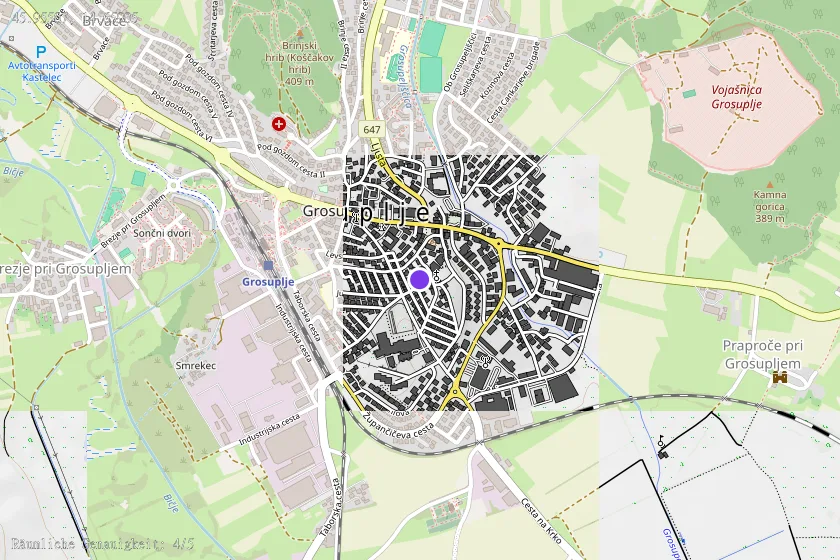
Location & map
Map position available (Point) · spatial accuracy: 4 — Accurate