PoH-Code: poh.10036
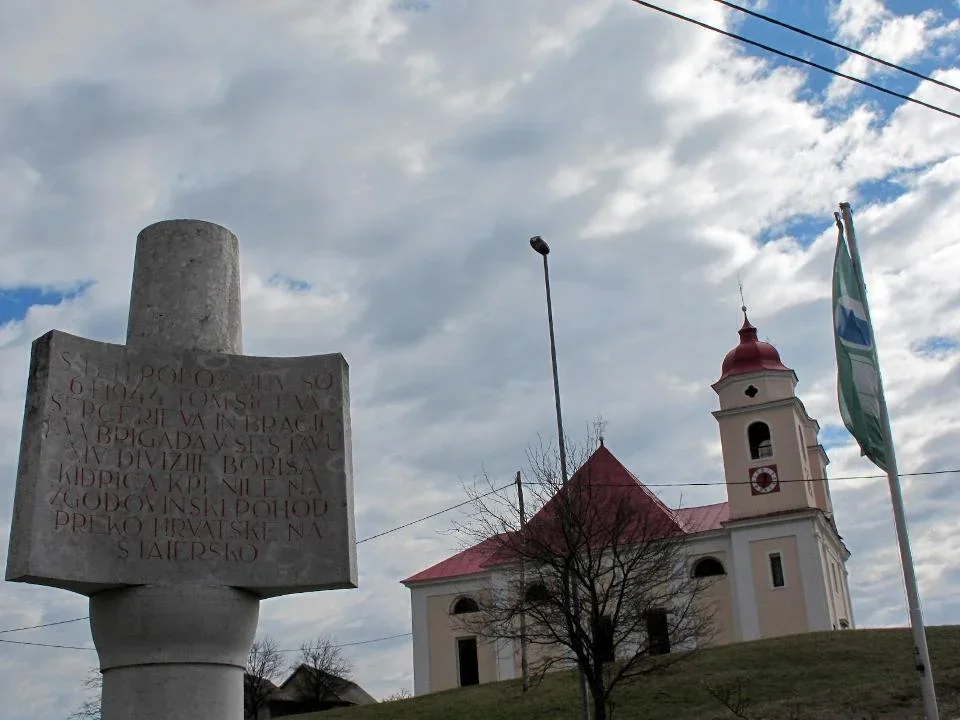
Dolnji Suhor-Spomenik 14. Diviziji - beginning of the battle path to Styria.
—
partizanstvo.si / Arhiv Geopedia · CC-BY 4.0 (privzeta licenca) · Preneseno iz Geopedije.
Monument was erected by the main committee of the Union of Fighters of the People's Republic of Slovenia on 21 July 1954. The design was prepared by architect Franci Šubelj.
Historical background:
The Fourteenth Division was established in July 1943 as a result of
the reorganization of the Slovene partisans' army, which coincided with the reorganization
of the Yugoslav national liberation army, in order to thus successfully
prove to the allies as a legitimate military force in the fight against
Nazism and fascism. The Supreme Staff of the National Liberation Army and Partisan
Units of Yugoslavia confirmed the establishment of the 14th and also the 15th divisions, which thus became the first divisions of the newly reorganized
Slovene national liberation army. Within the 14th division, several brigades were later
established, but throughout the war it was composed of three – Tomšič's, Šercerjev's and Loška brigade (also known as Bračič's). From October
1943, the division became part of the 7th Corps of the National Liberation Army and Partisan
Units of Slovenia, and from the end of February 1944 until liberation, it was part of the fourth operational zone, which covered Styria.
In December 1943, an idea was formed in agreement between the supreme commander of the National Liberation Army (NOV) and partisan units (PO) of Yugoslavia, Josip Broz Tito, and the leadership of the Slovene liberation struggle, to send the 14th division to Styria with the aim of strengthening military presence and for the division to serve as a necessary basis for the expansion of the third Slovene corps within the Yugoslav National Liberation Army. The national liberation struggle in Styria, however, was indeed expanding considerably more slowly than in other Slovene regions, since the German occupier had inflicted numerous heavy defeats on the liberation movement in Styria in 1942. A very suitable reason for the deployment there was also the opportunity for a significant increase in the military strength of the NOV; compulsory German mobilization of Slovenes into the German army had started to lose momentum in Styria by the end of 1943, and it would have been a waste to miss out on the military potential. With a considerably stronger army, Slovene national territory would then have been under thorough control by Slovenia upon the capitulation of Germany. The division was to begin operations in Haloz, where the liberation movement had not yet developed at all, besides that, the march offered the possibility of a surprise element for the occupiers. These were the two main reasons why the direction of the march was decided through Croatia.14th Division set out on the march on 6 January 1944 from Dolni Suhorje to
Beli Krajina (then still known as Suhor). Already during the one-month march through Croatia, it became entangled in fighting with the Ustashe; however, when it crossed the Sotla River on 6 February at Podčetrtka and thus also crossed the border, fighting with the Germans began. The Germans quickly organized themselves, started setting up blockades and encircling the division. The clash at Buče on the night of 7 February marked the beginning of the three-week German offensive against the 14th Division, in which the division repeatedly found itself in seemingly unsolvable positions, when the enemy attempted to encircle and destroy it, and in the end succeeded in pulling it out. The clashes took place practically everywhere, and the division was additionally tormented by severe frost, which dropped to as low as 20 degrees below zero; deep snow (at times even up to one metre); worn-out clothing and footwear; the burden of dead animals, which they had to carry themselves; and an increasing number of wounded, whom they had to carry with them or leave behind with peasants or in partisan hospitals, since in the surrounding area there was no liberated territory to which they could send them. All of this brought the division to the extreme limits of its physical and mental endurance. The German offensive lasted from the first clash at Buče on the night of 7 February until 26 February, and the division had to constantly break through the German encirclement rings. The worst fighting took place on Graška Mountain, also known as ''the mountain of the charge'', and at Bela Voda, the partisan poet Karel Destovnik-Kajuh also fell. In order to avoid the constant German pressure, the division split into four parts and successfully waited for the end of the offensive. One part broke through to Pohorje, while the others remained in the Mozirski Mountains.
It must be emphasized that without the support of peasants in the areas of Konjiška Gora, Paški Kozjak, Šaleško Hribovje, Mozirski Mountains, Kozjansko and Pohorje, it would not have been possible to sustain the German offensive, since by the time of its end, the division was already at the end of its strength.
The main reason why the Germans ended the offensive was the assessment that they had destroyed the division. In addition, the terrain over which the division moved was difficult to traverse and too vast for the Germans to fully control. Even greater difficulty was presented by the division's division into several groups, which prevented them from fully encircling and striking it.
The division set out on the march with 1112 fighters and fighters. The march through Croatia resulted in 7 dead, 29 wounded, 34 sick, and 10 fighters had to remain in the Kalniško Pogorje and guard the stored ammunition. During the risky crossing of the Sotla River, 1025 fighters and fighters remained in the division. When on 26 February the offensive came to an end and the fighting ceased, the division had a total of 440 fighters left, enough healthy for combat (about 40%); 305 wounded, while the number of dead, captured and missing amounted to 367 (almost a third). On the German side, between 500 and 600 soldiers were killed or wounded, or a fifth of their military strength.
Within less than two months after the end of the offensive, the division had already recovered so much that by April 1944, it consisted of almost twice as many fighters as it had at the end of February. The influence of its actions was felt throughout Styria, for the intensity of the liberation movement was rapidly increasing, and the general mobilization was strengthening the units of the 4th Operational Zone and 7th Corps of the NOVJ in the Dolnja region. The fighting lasted until the liberation for a total of about 22 months and is considered a symbol of the national liberation struggle in Slovenia.
Sources:Marjan Žnidarič, Na krilih junaštva in tovarištva, Ljubljana 2009
p. 107 - 142, 379 - 386.
Božo Repe, S puško in knjigo: narodnoosvobodilni boj slovenskega
naroda, Ljubljana 2015, p. 193.
EŠD 11208
Vodnik, 21, 23.
Pomniki naše revolucije, Ljubljana: Mladinska knjiga, 1961, p.
193.
Sources of the images:
Used with permission of the author, available
at: http://spomeniki.blogspot.si/2012/05/dolnji-suhor-pri-metliki-spomenik-14.html
Detailed information about the 14th Division on:
Campaign of the XIV Division to Styria
In order to accelerate the armed uprising in Styria, the Main Staff of the
National Liberation Front and the People's Liberation Army of Slovenia, in
agreement with the Supreme Staff, sent the XIV Division to Styria.
On 6th January 1944, Tomšič's, Šercer's and Bračič's brigades, consisting of
a total of 1112 well-equipped and armed fighters, left Suhorje and the
neighbouring villages on their way.
After one month's march, crossing the Ravaška, the division crossed the
Sotlo in the night of 7th February 1944 and entered the territory of Styria
where it fulfilled its mission despite extremely adverse weather conditions
continuously fighting with much stronger German forces.
The XIV Division, proclaimed an assault division on 26th October 1944 and a
proletarian division on 2nd November 1951, was renamed by the order of the
Supreme Commander of the People's Liberation Army of the Federal People's
Republic of Yugoslavia (FPRY) Marshal Josip Broz-Tito on 14th April 1953 into
the XIV Proletarian Division Borisa Kidrič.
The memorial on the road to Suhorje was unveiled by the Main Office of the
Central Committee of the League of Communists of Slovenia on 21st July
1954. It was designed according to the plan of architect Francija Šublj.
Source: archive of the Central Committee of the National Liberation Front of
Metlika (83)
Vodnik po partizanskih poteh, Ljubljana: Založba Borec, 1978, str.
138.
Translation · AI tier 5
Sources
- Partizanstvo.si — Partizanski spomeniki (#768) (f5074285-50a8-4393-8501-0d5bc2b0614b) — Partizanstvo.si — Partizanski spomeniki (#768)
Links
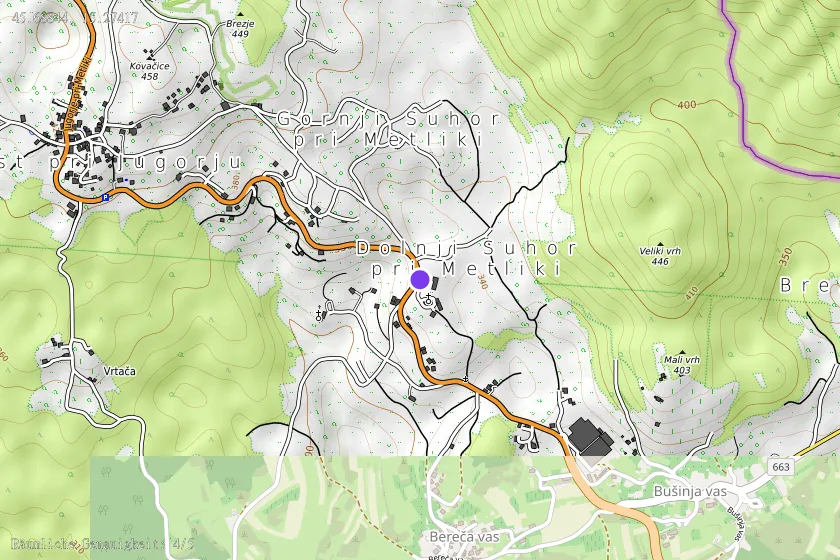
Location & map
Map position available (Point) · spatial accuracy: 4 — Accurate
Textual location description
Spomenik 14. divizije se nahaja v vasi Dolnji Suhor pri Metliki (št. 1), ki leži ob magistralni cesti Novo mesto – Metlika. Postavljen je v bližini župnijske cerkve sv. Jožefa, zraven osnovne šole Suhor.