PoH-Code: poh.9648
Franc Osojnik in Franc Kramberger, Krčevina pri Vurberku
—
partizanstvo.si / Arhiv Geopedia · CC-BY 4.0 (privzeta licenca) · Preneseno iz Geopedije.
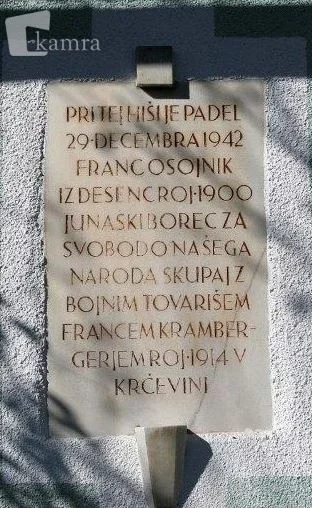
At Krambergerjevi House, there is a memorial plaque dedicated to Franc Osojnik (1900–1942) and Franček Kramberger (1914–1942), who fell here on 29 December 1942. The placement of the plaque was proposed by the Ptuj Committee of the Union of Fighters, and it was carved by the stonemason Mrevlje from Ptuj. It was placed on 29 December 1962. Dimensions of the plaque: 80 x 50 cm.
"Before the unveiling of the memorial plaque at the site of the death of Franc Osojnik, a great freedom fighter, in Krčevina No. 60 near Vurberk, a partisan and organizer of the liberation movement in the Ptuj area, Franc Osojnik, passed away twenty years ago. Exactly on the same day, on Saturday, 29 December at 10 in the morning, the local committee of the Union of Fighters, together with the KO ZB NOV from Grajeni, will unveil the memorial plaque at the site of his death. The school from Grajeni will participate in the ceremony. Due to the winter, the ceremony will be modest, but the organization of the Union of Fighters has decided to unveil the memorial plaque exactly on the day of the martyr Osojnik's death, thus concluding this year's commemorations on the 20th anniversary of the Slovenj Gradina partisan unit. Next year, in the summer, a larger celebration will be held in his memory at the site of his death. Schools will also organize excursions to the area where one of the largest revolutionaries in our area fell.
The hero of the national liberation struggle fell twenty years ago. On Wednesday, 29 December, twenty years ago, in Ptuj, the body of the hero Franc Osojnik was brought in a small cart, attached to a Gestapo car. Before the peasant house in Krčevina No. 60, he fell suddenly due to betrayal – his body was shot by the enemy. His body was buried at the city cemetery, where his deceased comrades, the national hero Jože Lacko, Franc Kramberger, Alojz Zavec, Stojko Drago, and the Reši brothers, had already been lying since August.
When did Osojnik become a fighter for rights? Franc Osojnik was born on 26 August 1900 in Janeževci in the Slovenian Gorice. He learned the miller's trade. He was a curious child, who already read a lot when he was in elementary school in Destrnik. Through reading, he became a free-thinking spirit and joined the 'Sokol'. Even then, he still reached for the school library books and participated in the plays that the community organized. With a desire to know foreign places and his homeland, he traveled throughout Yugoslavia and other Balkan countries.
When Osojnik became familiar with the Marxist world view and adopted it is not entirely clear. He was Lacko's friend. Lacko joined the Communist Party in 1932. At that time, the Associations of Peasant Youth and Girls began to be established under the influence of former members of the Independent Peasant Party. The Communists introduced an advanced spirit into the community. Lacko had a great role in this, and one of the greatest was that he brought an educated farmer, Franc Osojnik, into the cause of socialism. Osojnik was a solid support for Lacko's work in the Union of Peasant Youth and Girls, especially in his home area of Destrnik. At the elections of 1932, he helped agitate against the ruling list, organized meetings in the local area, where Jože Lacko would come and speak to the people about the right that they must claim for themselves."When the occupier broke in. Franc Osojnik became a revolutionary at his most, precisely when his homeland was in the greatest danger, during the period of fascist occupation. At that time, he was among the most courageous fighters for the liberation of our people and for their better future. Nothing held him back from his struggle, neither the thought of death, nor the thought of his family, his wife, his mother, whom he loved very much. Already in 1941, illegal fighters had gathered at his house in Desence. Osojnik visited reliable people throughout the Slovenian Gorica and recruited them for the OF. His house was a gathering place for communists, organizers of resistance against the occupier.
Osojnik himself, of course, did not know that his house was under surveillance, which was probably the case, since the occupier's document from 1941 was preserved, which speaks of the political unreliability of Franc Osojnik.
With Lacko, they worked for the OF hand in hand. They covered almost all areas of the Slovenian Gorica and planned resistance centres. They brought with them the OF's illegal press and collected contributions.
In 1942, Franc Osojnik left for Rogasko Slatina in March, where he operated in the vicinity of the Regional Committee of the OF and KP for Styria. There, he reported on the situation of the OF in the Ptuj district, on the people's resistance to the occupier, and on the occupier's brutality. With the task to establish a partisan group in the Ptuj district, he returned to his home area together with Mimo Kovač-Barčko, the wife of the fallen hero Štefan Kovač. Barčko entrusted the Regional Committee of the KP with the leadership of the KP in the Ptuj district, while Lacko led the work of the OF. Strong support for them was Franc Osojnik, whom the PK of the KP had designated as the leader of the partisan group, which was to be established as soon as possible. Mirna Kovač-Barčko says in her memoirs that Osojnik could not be sent immediately to the partisan unit as a commander or political commissar, because he was urgently needed to consolidate the OF's positions throughout the Slovenian Gorica and elsewhere in the district. Osojnik knew the local areas and people very well, and Lacko could not take on the responsible task alone, consolidate the positions, and find reliable bases for the first armed group in the Ptuj district, as he was too compromised.
Osojnik joined the group shortly afterwards and took over its leadership in May. Toplak Janez from Mostje says that this happened during the first raid. He came to Mostje by bicycle, with a knapsack and a carbine, wrapped in an old sukna. He asked for a place to rest. A few days later, other partisans came to Toplak and slept on the meadow. Around the 20th of June, they moved to an underground cave in the nearby hill. From there they went on actions, sometimes they were not there for a few days, then they returned.
After the battle at Mostje. Osojnik was a brave fighter, as testified by the surviving collaborators of the Slovenj Gradec unit. Although the conditions of the battle were extremely harsh, the unit attacked the occupier's positions throughout the Slovenian Gorica in a heroic manner.After the battle at Most 8 August 1942, Franc Osojnik, with a wounded, bleeding hand, unable to fight, slipped out of the enemy's circle. He took refuge in Pesnica and hid under a shelter by the riverbank, where he waited until nightfall, until the soldiers and Gestapo had withdrawn from the battlefield. Late in the evening, he slipped from his hiding place into the water and set off along secret paths to Vičava, where he, exhausted from blood loss, hid in an abandoned barn near Selmajer. His wounded leg was treated by Olga Meglič, who also brought him food. A few days after the battle, he appeared on Panorami at the permanent radio station, where Barčka came. It was a most sorrowful meeting. They talked about the unit, about its defeat, about the death of brave fighters. Barčka says that Osojnik was like never before, old, pale, with a fallen face. A few more days Osojnik had to treat his leg so that he could go on a journey to his relative Martin in Breg in Krčevina, where he spent the night in the forest. He slept with a revolver under his head and woke up immediately if he heard something stirring under the forest. Tov. Breg remembers that Osojnik told him how, with difficulty from the wounded leg, he had left that day, when Lacka were led through Ptujska, to the town, well camouflaged and had crept into the attic of the inn «Pri pošti», where he observed how the Lacka were beaten and spat upon by the Germans. Among the humiliators was also Bezjak from Krčevina, who had submitted to the occupier. To him Osojnik intended to give death. Someone brought him by motor a few days before Bezjak's house, and Bezjak received his deserved payment.
Osojnik's death. Osojnik had a friend, Franc Kukovč, from Krčevina, a corporal in the old Yugoslavia, and during the occupation, the administrator of Komelje's confiscated property. Already in 1941, Osojnik had recruited Kukovč into the OF and worked together with Osojnik and his friend Franc Kramberger, the farmer's son from Krčevina. Kukovč was twice imprisoned by the occupier. When he came out of prison the second time, he was in Gestapo service. In prison, he had yielded to the occupier, when the occupier offered him freedom or death, and freedom at the price of humiliation.
Osojnik went to the Ruško unit in September 1942 and became its political commissar. However, he often returned to the Ptujska area for special tasks. One day, upon arriving at the Ptujska area, he visited Kukovč at the Čermelov estate. Kukovč invited him to a smaller meeting of the OF at Kramberger's in Krčevina, number 60. The informant reported to two collaborators of the occupier to inform the mayor in Grajeni of Osojnik's arrival. Kukovč's wife also reported to the municipality that Osojnik had arrived and where he and his wife had gone. By phone, the municipality informed the Gestapo in Ptuj where Osojnik was. Within a few minutes, the Gestapo arrived by car and demanded that the mayor Petek and the secretary Herbst show them the way to Kramberger's. The house was surrounded. Petek called Kukovč through the window, who jumped through the window to the main entrance, Franc Kramberger fled through the kitchen to the plain, where Gestapo bullets struck him. Injured and bleeding, he ran to his neighbor Jakolič; the locals placed him in bed, where he bled to death.
When Kukovč jumped through the main entrance, he shouted out: «Another one!» Osojnik, meanwhile, wanted to flee, but was already shot by a bullet from the machine gun on the stairs.Kukovec then went to his neighbor Marušič to get a handcart, on which they placed the dead Osojnik and brought him to the village of Grajeni. During the night, they kept him at the village courtyard, and in the morning they took him to Ptuj, where they displayed him to the people on the Gestapo courtyard. The death of Osojnik meant a great loss for the national liberation struggle, yet his name inspired new fighters to courage, which was needed for the struggle to victory over the occupier. After Osojnik, a technique was named that printed magazines and brochures of OF. The prints of this technique have been preserved, but it is still not explained where it participated.
After liberation, the people's authority condemned to death those who betrayed the great hero and freedom fighter, Franc Osojnik. His name was taken up by the peasant cooperative in Ptuj. This year, on the 20th anniversary of his greatest heroism, the Ptujska občina (Ptuj municipality) named one of the city's streets after Franc Osojnik. The primary school on Ljutomerska street in Ptuj was also renamed after him. Do not forget the peasant - the revolutionary who fought heroically and died for the freedom of his nation!«
V. R., Before the unveiling of the memorial plaque at the site of the death of the great freedom fighter, Franc Osojnik, Tednik, Glasilo Socialistične zveze za Podravje 1/50 (28. December 1962), front page and page (2).
Franc Osojnik. Portraits of Slovenian regions.
Kamra, Knjižnica Ivana Potrča Ptuj.
Translation · AI tier 5
Sources
- Partizanstvo.si — Partizanski spomeniki (#5428) (9f50cdb0-d5a7-4b69-8640-3d85ba0afd46) — Partizanstvo.si — Partizanski spomeniki (#5428)
Links
Location & map
Map position available (Point) · spatial accuracy: 4 — Accurate
Textual location description
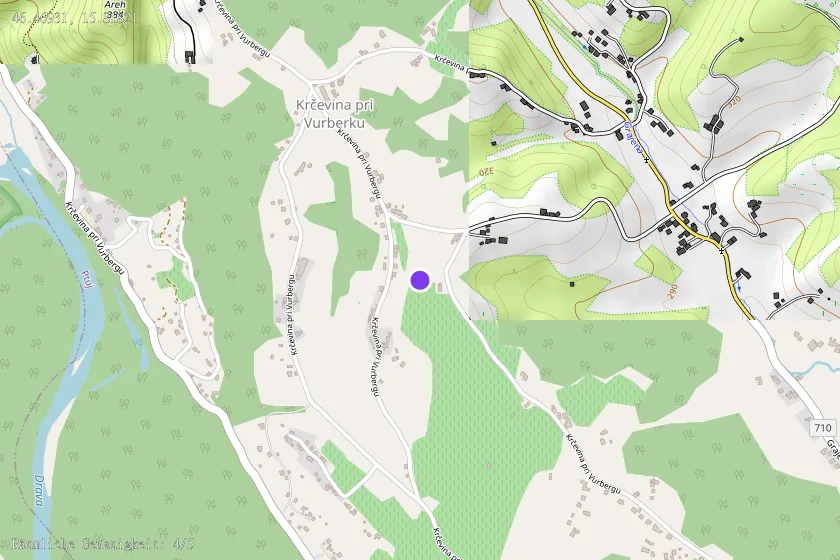
Preko naselja Grajena v levo do Krčevine 60.