PoH-Code: poh.17884
Baza 20, Kočevski Rog
—
partizanstvo.si / Arhiv Geopedia · CC-BY 4.0 (privzeta licenca) · Preneseno iz Geopedije.
MEMORIAL OF NATIONAL IMPORTANCE
The entire complex of Base 20 is well covered with informative boards, and also in the reception centre at Lukov House, an exhibition of the Dolenjska Museum is held, which is led by museum collaborator Jože Saje.
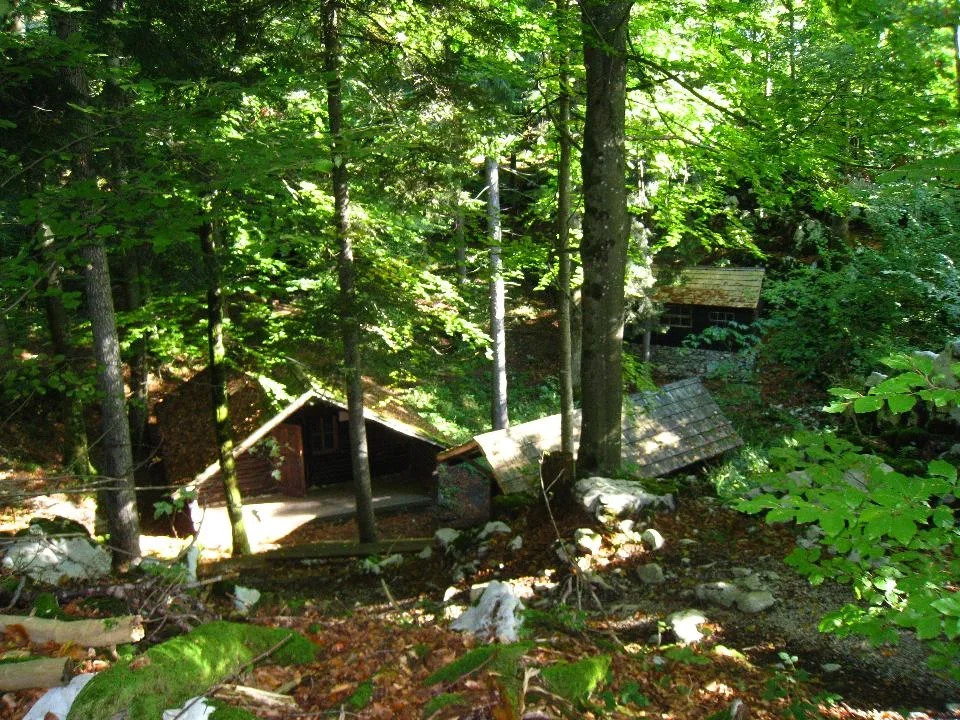
The only similarly built and preserved complex of the headquarters of the resistance movement during the Second World War in Europe consists of 26 barracks and a bunker. They were built from logs, planks and covered with bark.
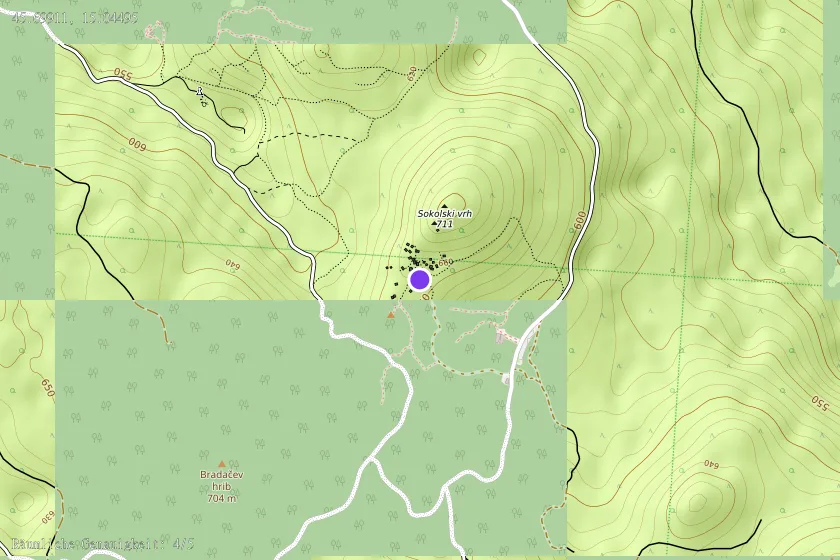
Above the Červanova road, which runs from Podturna along the north-eastern slope of the Kočevski Kraj towards Bukovac Hill and Travnik, near the Jelendol hospital at the elevation of 717 meters on the Sokolski Hill, a construction group under the leadership of Rudolf Ganzittija – Grad began building in March 1943 according to the plans of engineer Lojze Rojec, barracks for the leadership of the liberation movement, which was then located in the Polhograjske Dolomites, where it had retreated during the Roško offensive. The location was found by Dr. Pavel Lunaček – Igor, who had thoroughly familiarised himself with the Rog with the help of his personal escort August Bradača from Obrh, Dr. Marjan Brecelj and engineer Lojze Rojec, and it was approved by the then commander of the Slovene partisan army Ivan Maček – Matija.
The first barracks were built in the deep woods, where in the Roško offensive the Italians did not find the camp of Jurčet’s unit, constructed from dense wood found in Rog, planks from Spreitzer’s saws in the Stare Žage and material from the cottages. Later they raised and rearranged this barracks, which was used for a dining hall, a meeting room and a lecture hall. The other barracks were also built in nearby woods and on their periphery. Since there was not enough wood nearby, they prepared it on saws in Soteska and Stare Žage. The barracks served as accommodation and work space. They were named after individual institutions and forums, sometimes even after individual members of the liberation struggle, who were operating there at that time. They also built a barracks for the protective unit on the edge of the new settlement. In total, there were 26 barracks and four bunkers, of which one is still preserved.
How far from Base 20 was Base 21 on the Kragulj Hill, the headquarters of the main staff. It had several bunkers for storage of various materials. There was also the leader of the British military mission at our main staff, Major William Jones, in this base. Here they established the first military school for partisan officers, whose first course was in August 1943.
The political leadership of the Slovene resistance movement operated from Base 20 from April 17, 1943. Only its residents were allowed to come to Base 20, others only exceptionally, since its existence was concealed both from the enemy and from the other residents of the Kočevski Kraj.
Most of the residents of Base 20 did not exactly know where it was. To conceal their presence, they carried out a variety of imaginative conspirative and security measures. Access was only possible at one place and even then only with the help of a ladder, which the guard would lower each time. The arrival would grasp the ladder, climb up it and then climb safely onto the base. At that time, a young guest would hide the view towards the barracks behind a young fir forest. The occupier of Base 20 never discovered it and it was the only one built and preserved in such a way in Europe as the headquarters of the resistance movement.After the break-up of Italy, the CK KPS, IO OF and the main staff moved to Soteska, while the propaganda commission and editorial offices of the newspapers first moved to Dolenjske Toplice and then to Podhosto and Suhoř. During the German offensive of 1943, the leadership moved back to Base 20, but after three days, it relocated to the bunker near the technical site «Urška 14». When the one-day harassment of the Germans at Rog ended, the leadership of the liberation battle withdrew to Seč nad Črmošnjicami, and then returned to Base 20, where it remained until 19 December 1944, when the CK KPS and IO OF moved to Dobličko gora in Bela krajina.
The only fully constructed and preserved complex of the leadership headquarters of the resistance movement during the Second World War in Europe consists of 26 huts and a bunker. They were built from logs, planks and covered with bark.
More about Base 20
on the website of the Dolenjski Museum
Monuments of our revolution, Ljubljana: Mladinska knjiga, 1961
pp. 154-155.
EŠD 271
Translation · AI tier 5
Sources
- Partizanstvo.si — Partizanski spomeniki (#901) (82dd2718-8f93-43fa-8f07-fb3be5a82c28) — Partizanstvo.si — Partizanski spomeniki (#901)
Links
Location & map
Map position available (Point) · spatial accuracy: 4 — Accurate
Textual location description
Nahaja se v Kočevskem rogu, nedaleč od Červanove ceste. Oddaljena je približno 25 km od Kočevja. Skoraj čisto do Baze 20 se je možno pripeljati z avtomobilom, le del poti čisto pri Bazi 20 je potrebno prehoditi peš (približno 5-10 min hoje). DOSTOP: 1. Iz smeri Ljubljane mimo Soteske in v vasi Podturn desno v gozd – sledi nekaj kilometrska asfaltna cesta do Baze 20. 2. Iz Novomeške smeri skozi vas Podturn, na križišču v vasi desno in na koncu vasi levo v gozd – sledi nekaj kilometrska asfaltna cesta do Baze 20. 3. Iz Belokranjske smeri po "Partizanki" skozi Podturn naravnost v križišču in na koncu vasi levo v gozd – sledi nekaj kilometrska asfaltna cesta do Baze 20. 4. Iz Kočevske smeri lahko kar skozi Kočevski rog do Baze 20 ali po cesti skozi Smuko do Dvora, nato desno do Soteske, kjer se desno odcepi partizanska magistrala do Podturna in v križišču pred Podturnom desno v gozd po asfaltirani cesti do parkirišča pod BAZO 20. Lahko pa južno čez Črnomelj, ali severno skozi Ribnico in naokoli po avtocesti do Novega mesta, nato do Dolenjskih Toplic in do Podturna na križišču v vasi desno in na koncu vasi levo v gozd – sledi nekaj kilometrska asfaltna cesta do Baze 20.